Well, the wait is over, and the Rugby World Cup is now fully underway in France, and what a fascinating tournament it’s already proving to be. There are the usual controversies, starting with the opening ceremony, which some of us found a wee bit confusing at times, to say the least. Then there was the nightmare on Elm Street with the National anthems in the first weekend, which the organisers have, thankfully, now fixed. However, more problematic are the ongoing issues surrounding a lack of consistency in refereeing decisions, as well as what can only be described as too much officiating at times, which can sap the joy out of contests. Nevertheless, despite all of this, it’s already shaping up to be a tournament that is coughing up plenty of surprises, which are perhaps a direct result of the slightly lopsided nature of the draw. Our overall impression, however, is of a tournament that is already keeping us glued to our TV screens, with plenty more entertainment to follow and drama to unfold. It’s still our sport’s greatest festival, and we’re loving every minute of it.
We’ve attempted to watch every single game since opening night, and with that and the usual pressures of life, it’s left us little time to get thoughts down on paper. So for the pool stages we’ll likely be putting one missive out during the halfway point as this piece is and one at the end, and then resume normal service once we’re into the quarters and a more manageable viewing workload.
We’ll dive into some overall impressions of the tournament in general and then get into the nitty gritty of how we think each of the four Pools are shaping up after the first two rounds. So without any further ado, here’s what kept our numerous pints frothy over the last two weeks.
No World Cup is without its controversies – one is ongoing and another much to the delight of fans has been fixed
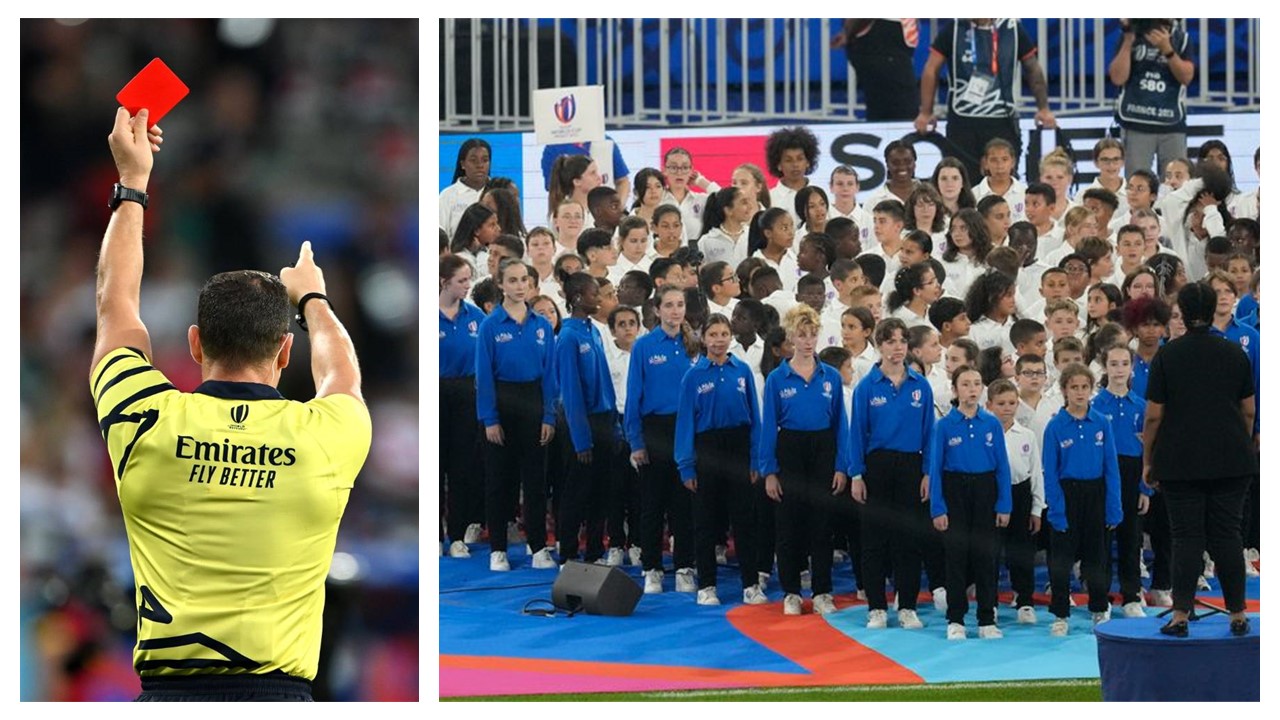
Well, the World Cup got underway with an interesting opening ceremony, as that’s probably the best way we could describe it. Opening ceremonies, for the most part, tend to leave us a bit cold and seem to be a mere formality that one has to get through before the real action begins. The spectacle at the Stade de France was lavish, but we’re not sure we really got the message or its connection to rugby and the 200th anniversary of the first time William Webb Ellis decided to pick up a ball and run with it. Nevertheless, on a sweltering evening in Paris, the main event was soon to come, and we weren’t disappointed.
However, La Marseillaise, which surely has to be one of the greatest anthems in rugby, was really not done justice despite the best efforts of some committed school children. Don’t get us wrong, we applaud the efforts of these children who have mastered all 20 different anthems in a variety of languages. However, without accompanying musical instrumentation, such great pre-game rituals sadly got lost, and the delivery was slightly surreal and rather hollow. Players and fans alike looked lost and confused and struggled to sing along. Nevertheless, give the authorities full credit as after the first weekend all the anthems have been reworked to include instrumentation and the result is now so much better, while still preserving the remarkable efforts of the children involved.
Like any major tournament there were the inevitable teething troubles on the first weekend which do seem to have been rectified, most notably the chaotic crowd scenes and entry to stadiums particularly at the England/Argentina game in Marseille. However, the major issue that continues to dog the tournament is the officiating, which sadly seems to be a topic we just can’t seem to stop talking about this year.
World Rugby has adopted the bunker system for yellow and red cards where instead of sucking up huge chunks of game time as referees and TMOs dissect endless footage of incidents on the big screen, yellow cards are handed out and then the incident is given to the TMOs to review to determine whether said offence should then be upgraded to a red. All sounds great right and a positive addition to the process. Unfortunately, however, it has been marred by glaring inconsistencies. Some offenses aren’t even flagged, while others get scrutinised to death, and the offending players dealt harsh sentences. Some cards that should be red simply remain yellow, leaving players and supporters frustrated and confused. In short, it’s messy and once again smacks of inconsistency while leaving newcomers to the game bewildered and completely unsure what the rules really are from one game to the next. We’re not sure what the answer is here, and we doubt very much that we’re going to see any positive corrections during this World Cup.
Perhaps our biggest sticking point, however, is the tendency for almost every try to end up under review. While we agree that some tries do need to be examined as to whether or not the ball actually made it across the line, or there weren’t any transgressions leading up to it, the almost constant micro analysis of every single whitewash crossing is taking some of the pleasure and euphoria out of the game. A kicker is lining up for the conversion, and then all of a sudden, the referee is seen pressing his earpiece closer to his ear to overcome the noise of thousands of elated fans. Next thing, the arms come up framing a TV screen, and the joy gets sucked out of the game for the next five minutes. We understand the reasoning behind it, but there is definitely a bit of a disconnect going on at times, as rugby appears to be turning into some sort of hybrid exercise between players, fans, and video lawyers. Match officials should be allowed the benefit of the doubt unless it’s blatantly obvious that the try is questionable. This might help grow the game to new audiences as well as increasing the enjoyment for the thousands of committed fans in the stadiums and those crowded around TV screens in living rooms and bars across the world.
Uruguay make a statement for all Tier 2 countries by giving France the scare of their lives, while New Zealand make short work of Namibia and discover a rapidly rising star

So as we break down the Pools we reflect back on how we predicted the teams would finish, and when it comes to Pool A we think it’s fairly safe to say that the likelihood of France finishing first and New Zealand second still looks on cue, but we simply have to give Uruguay a massive shout out after they gave France a very loud wake up call.
France opened the tournament in style by beating New Zealand comfortably in the end, in a second half performance that saw them pull out all the stops. They ran the show, and although New Zealand had slightly more possession, France ensured that they could do little with it. Although both sides scored two tries apiece and New Zealand came storming out of the blocks at the opening whistle and scored the first try within the opening two minutes, the focus of the match soon centred on France’s ability to disrupt the New Zealand game plan. Once again in the opening stanza of the second half the All Blacks looked to set the pace with another try from winger Mark Telea inside the opening two minutes, but that would be the last hurrah for New Zealand.
Thereafter, it was the Fabien Galthie show for the last half hour with both of France’s sublimely executed tries coming in the second half. New Zealand was doing infinitely more work than their French counterparts, yet were failing to execute in the red zone, despite France missing twice the number of tackles – something which will be making France’s defensive brains trust pound their whiteboards in frustration. However, the All Blacks were not having a good day with the boot and their discipline was laughable as they conceded 12 penalties to France’s 4, including a yellow card for fullback Will Jordan who was lucky not to see red. France sealed the deal with a spectacular try from Melvyn Jaminet and the rest is history. However, the match left many of us with an overriding impression that neither side are invincible.
That was reinforced by France’s second game against Uruguay. In short what a performance from the South Americans who laid down a marker that the big teams will write Tier 2 teams off at their peril, something which France clearly appeared to do. France were made to sweat in that match, and then some, as they looked well off the pace to the point where the first historic upset of this World Cup seemed a distinct possibility. France regathered themselves in the final quarter as they found themselves a mere point ahead of Uruguay. France’s defense looked shaky once more as Uruguay out tackled them. The South Americans also had the edge over France in the rucks for large chunks of the match, and neither side’s scrums were particularly effective, with the French fortunately managing to salvage some set piece dominance at lineout time. France’s discipline as well was a complete drop off from their performance against New Zealand as they conceded 15 penalties and one yellow card for second rower Romain Taofifenua, who to be honest was extremely lucky not to see red.
Les Bleus got the job done but will need to get their house in order for their final Pool encounter with Italy, who must have watched the game with an increasing sense of optimism. France still look set to top the Pool, but if they are to go deep into the tournament, they will need to up their game.
New Zealand still look set to finish a comfortable second, and with the France game out of the way, the rest of the Pool stage should be relatively plain sailing for them. The opening game against France showed some weaknesses that teams will be keen to exploit in the knockouts, particularly their defensive and disciplinary lapses, as well as the fact that their scrum is adequate but not world beating Their second game against Namibia, despite a brave effort from the Namibians, was essentially a glorified training run for the All Blacks. Their goal kicking, however, is still not quite up to their usual standards, and their discipline remains lamentable at times, with Prop Ethan de Groot seeing red in the match. Their remaining two encounters with Italy and Uruguay should ensure them the two wins needed to finish second, but the Italians will be a tricky proposition especially if the All Blacks’ discipline continues to trip them up, and Uruguay will make them think twice about letting their guard down, especially if Italy end up being a banana skin for France.
However, scrum half Cam Roigard who was Man of the Match against Namibia, laid out his credentials in some style as the candidate most likely to succeed the legendary Aaron Smith when he retires at the end of this World Cup. Not shy of physical contact, Roigard has already shown excellent decision making, and his ability to spot space makes the case for fast tracking him into a starting role in the All Blacks squad come the New Year an absolute priority.
Italy still look likely to finish a strong third, but will be licking their lips at the prospect of their final encounter with France. At this stage it’s hard to judge where they are as we’ve only seen them put a hapless Namibian side to the sword in their opening game. Their fixture this week against an impressive Uruguayan side brimming with confidence will be excellent preparation for their two big encounters with New Zealand and France.
Uruguay could be the surprise package of this Pool, as after their outstanding performance against France, they must surely fancy their chances against Italy. Uruguay made a clear case for Tier 2 countries having more games against Tier 1 nations in Lille last Thursday. They have a dynamic forward pack and some electric backs. They move the ball around with enterprise and are an absolute handful at ruck time. In short, we’re billing Wednesday’s encounter with Italy as one of the games of the week. They will sadly probably be brought back down to earth with a crash in their final Pool game against New Zealand, but in the process, it will have provided us with some genuine excitement. Still a strong fourth place finish and perhaps better, if they can build on their form against France, is on the cards for one of the Tournament’s most promising prospects for the future.
Last but not least, Namibia soldier on despite being clearly destined for Pool A’s Wooden Spoon. Brave but completely outclassed by both Italy and New Zealand, Namibia can still feel encouraged by a never say die attitude that has won the hearts of those in the stands, despite the odds being massively stacked against them. Perhaps their only real shot at glory will be when they take on Uruguay in their final fixture, but after watching the South Americans put the fear of God into the French, even that looks to be a bridge too far for Namibia. Their tackling and defensive work is simply not up to the standard required at this level, while their lineout and goal kicking efforts also need some serious surgery. They can take comfort in a relatively successful work rate come scrum time, and they are fairly effective at winning their own rucks. However, a lot of that good work then gets undone by poor execution and discipline. Namibia will exit stage left on September 27th without ever really having fired a shot, but expect to see them back in Australia in 2027, hopefully in better shape.
Ireland appear to be building rather well as Sexton makes history and South Africa put Romania to the sword setting up THE clash of the Pool stages next weekend!
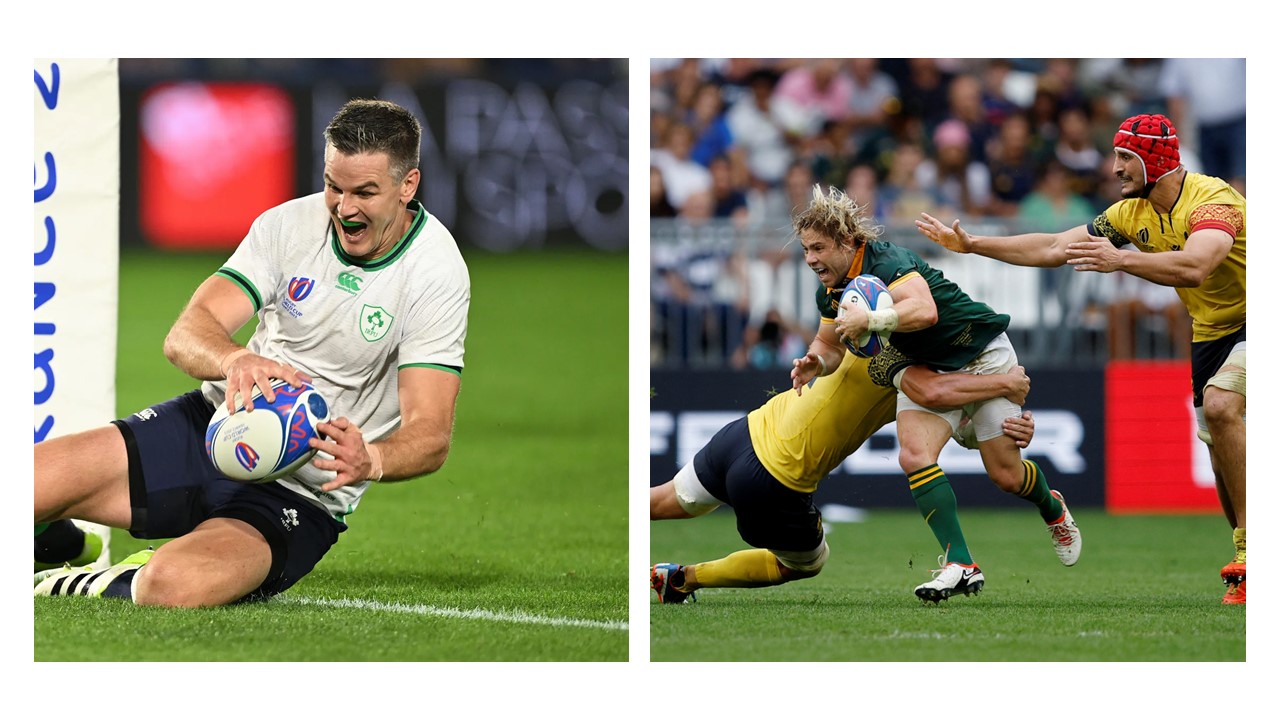
The talking point of the World Cup is now the Clash of the Pool B Titans, as Ireland and South Africa look to face off against each for the first time ever in the global showpiece when they meet in Paris this Saturday. It’s already being billed as THE game of the Pool stages. However, in the Tournament’s Pool of Death, there are still no certainties. South Africa may have dismantled Scotland, but the Scots still have three matches ahead of them, while Ireland have yet to be really tested. Meanwhile, Tonga and a very disappointing Romania bring up the rear.
We’re still sticking to our hunch that South Africa are going to top Pool B, but don’t feel overly confident in our crystal ball gazing skills on this one. One can’t really judge South Africa based on their demolition of an exceptionally weak Romanian outfit, but their performance against Scotland was impressive. They simply suffocated Scotland and denied them any of the creativity that they are known for. The statistic that really made us take a deep breath in that game was the fact that Scotland, a side who traditionally love to run the ball, only managed to make a measly 229 metres compared to South Africa’s 610 in that match. South Africa simply denied Scotland the right to play in that opening weekend. South Africa’s defence missed a few more tackles than the Scots who looked defensively sound for much of the match, however, the physical toll of absorbing all those metres made by South Africa left the Scots dead on their feet by the final quarter. South Africa maintained their discipline and their work in the lineouts, and at the rucks was exemplary. Their scrum, although not exceptionally effective at times, made mincemeat of the Scots, who, by comparison, struggled to gain any parity at the coalface. Nevertheless, fly half Manie Libbok’s issues at the kicking tee came back to haunt the Springboks with a vengeance as Faf de Klerk had to be drafted into to restore some confidence when it came time to kick for goal.
In their second match they completely blitzed an abject Romanian side so it really is hard to judge where this Springbok side is in relation to everyone else, especially as their kicking problems off the tee continued to plague them along with a scrum that could still be more effective. Their power and physicality should be enough to stifle another creative side in the shape of Ireland, as well as dispatching Tonga as a warm up for whoever they end up facing in the Quarter Finals. We think the defending Champions have shown enough to make them favourites to top the Pool, but we’re not putting any money on it until Ben O’Keefe blows the final whistle on Saturday in Paris.
Ireland have looked impressive since day one of this tournament, but even more so than South Africa it’s really hard to judge where they’re at, having only played the Pool’s two weakest teams so far. Romania and Tonga have made this Irish side so far look nothing short of spectacular. The cobwebs have all been blown off after a relatively gentle series of warm up games in August, and there is no denying that this Irish outfit look arguably the most cohesive and well organized group in the tournament to date. However, there is no denying that this warm fuzzy feeling may all evaporate into the ether come the end of Saturday’s bruising encounter with the Springboks. Ireland have also managed to remain for the most part injury free, and what injuries they do have are being carefully managed, but that could all change come Saturday. The Irish are also the most disciplined side so far this tournament and with Ireland Captain Jonathan Sexton back to his very best after a six month absence, it’s hard to argue against Ireland potentially going deep into this tournament for the first time ever.
There was little, if anything, to criticise in their thrashing of Romania other than the fact that their lineout left a lot to be desired, boasting a relatively feeble 67% success rate. Against Tonga, who were much more resilient opponents, the scoreline may have been not quite as awe inspiring but the efficiency of the performance was a clear step up from the game against Romania, even if Ireland’s discipline let them down slightly at times. However, their set piece and phase work was exemplary and boasted an average of 95%. Jonathan Sexton became Ireland’s all-time leading points scorer pipping the legendary Ronan O’Gara. Have we seen the best of Ireland yet? Definitely not but whether or not Coach Andy Farrell and his charges have enough tricks left up their sleeves to get past a Springbok juggernaut that, barring one or two weaknesses, is veritably purring remains to be seen. Bring on Saturday!!!!
Scotland have only played one match so far, and we always had the feeling that against a South African unit oozing with confidence after demolishing New Zealand only ten days previously, their tournament was always going to get off to a rough start. Consequently, now the real work for Scotland begins with all eyes focused on what happens between South Africa and Ireland this weekend. Scotland were simply not allowed to play by the Springboks, and in key areas such as the scrum and lineouts, South Africa put them to the sword. They are back in action against Tonga this weekend and should have had enough recovery time to get themselves back on the board and get the points clock ticking again in their favor. That’s followed by what should be nothing more than a training run against Romania ahead of their do or die winner takes all encounter with Ireland in their final Pool match.
Scotland may not have started the way they would have wanted, but to count them out after just one match would be utterly foolhardy. Nevertheless, given Ireland’s massive point hauls against Romania and Tonga, as well as South Africa’s against Romania, Scotland have a rather daunting mountain to climb if they are to get out of the Pool, and definitely need some lucky breaks. They are a quality side who unfortunately find themselves in a Group in which it will be hard to gain the parity they need, and as a result we can’t help feeling that a strong third place finish is the best this spirited and highly talented Scottish side can hope for. Nevertheless, if there is one team that can throw the form book out the window and rumble the established order, Scotland, along with Fiji, are your best bets this tournament.
Tonga, in their only match so far against Ireland, showed they can be a tough side, but one which is unlikely to cause any of the bigger, more established teams too many sleepless nights. We just can’t see them really troubling Ireland, South Africa, or their opponents in their second match this weekend – Scotland. Defensively, they look ill equipped to match the speed and creativity of South Africa or Scotland, having missed 35 tackles against Ireland, while their lineout was a complete and utter disaster. They will take comfort in the fact that Romania should be an easy win for them, and with it, a face saving fourth place finish.
Romania have sadly not been at the races in this tournament, and regrettably look set to be the team more than any other who are there simply to make up the numbers. Their best moment was their opening three minutes in their first game against Ireland, but since then, it has all gone downhill at a rate of knots. Their discipline is poor, and they seem completely out of their depth against quality sides such as South Africa and Ireland. It won’t get any easier against Scotland, and their final game should see a fired up Tongan side who is likely to have improved with every outing. There has been plenty of heart but it simply hasn’t been enough to bind together a team that appear to have little or no game plan, and is lacking in terms of their ability to execute the basics of the game under the kind of pressure that a tournament like this generates. We wish them well, but they will leave this World Cup at the bottom of their Pool knowing that a massive rebuilding programme lies ahead of them if participation in the tournament in Australia in 2027 is to be considered as a realistic ambition.
Fiji make history and rightfully claim their place at Rugby’s Top Table, while Portugal rattle Wales and continue to further the calls for Tier Two nations to have more exposure to the big boys!

We are THOROUGHLY enjoying this Pool, and it is clearly the most competitive of all the Pools. After two weekends, it is now very much the tournament’s second Pool of Death. The game between Fiji and Wales was one for the ages, and the Pacific Islanders’ historic win over Australia last weekend has now made it a do or die affair for the duration of the Pool stages for all three front runners in Pool C – Wales, Australia and Fiji, with the Wallabies arguably the side with the most to prove. Meanwhile Georgia and Portugal bring up the rear, but have still managed to make everyone sit up and take notice, and as a result a shock upset against the three top outfits in the Pool is not beyond the realms of possibility.
Wales have reverted to a proud World Cup history by proving that form heading into a World Cup is a many layered beast. They are often able to raise their game come the global showpiece and show every sign of doing so again this tournament. Their nail-biting win over Fiji was a combination of grit, determination, and just a little bit of luck. However, at the same time, they also showed tremendous ambition and as so often happens, under the tutelage of Coach Warren Gatland, their defense becomes almost superhuman. It was the game of the tournament so far, and Wales’ ability to hang on despite a Fijian side growing in confidence and ability as the match wore on was impressive. Fiji tried every trick in the book, but somehow, against all odds, Wales managed to slow them down or force them into errors. Fiji’s relentless assault on Wales was a genuine test of character and resolve. Fiji outplayed Wales, but Gatland’s men somehow managed to contain them while at the same time creating enough opportunities of their own to keep the scoreboard ticking over in their favor. Some have argued that their discipline could have been infinitely more costly and had referee Matthew Carley been harsher with Wales, but that’s a debate for another day.
In their next game against Portugal, it wasn’t nearly as inspirational a performance as that against Fiji, and at times Wales were clearly having difficulty in getting to grips with an opponent who was causing them far more difficulties than they had bargained on. Their lineouts fell apart, and Portugal proved very effective at disrupting Welsh efforts to develop any kind of momentum. It was a scrappy affair that Wales comfortably won in the end, but it brought them down to earth with a thump. Perhaps that’s no bad thing ahead of their encounter with Australia this weekend which could see them top their Pool, barring an upset in their final game against a Georgian outfit who have been a constant thorn in their side over the last few years. Wales appear on track to throw the form book out the window, making their clash with the Wallabies this weekend in Lyon, the second biggest game of the weekend.
Fiji as a result of that heartbreaking loss to Wales in the opening round, now look set to take second place in Pool C, unless the Wallabies do them a favor in Lyon this weekend and once more throw this Pool wide open. As mentioned above, Pool C has become the Tournament’s most surprisingly competitive and close fought group. In many ways, Fiji were the better side against Wales, yet at key moments, their execution was just a fraction off. Fiji’s biggest problem seems to be that they fix one area of their game, yet in doing so, another component goes astray. In the game against Wales, they boasted a 92% success rate at lineout time yet against Australia that percentage dropped to a disappointing 74%. Against Wales, their tackle completion rate was only 67%, yet against Australia, it went to a much healthier 82%. While many of the technical aspects of their game have vastly improved in the last four years, against both Australia and Wales, they still suffered at scrum time. Nevertheless, there is still plenty to be positive about as Fiji look set to get through to the knockout stages.
They will continue to get better, and what struck us the most about their game against Australia was they are now just as comfortable patiently grinding out a physical contest, as they are in open play and utilizing their outrageously skilled running game. This is a really good Fijian team that is only steps away from becoming a team capable of making history in this tournament and beyond. In short, the promise for Fiji is enormous, and World Rugby simply has to ensure that they are able to feature regularly in top Tier competitions from now on. The talent has always been there, but now it’s matched to all-around ability. Fiji’s hardest matches are behind them, though a tough contest awaits them in the shape of Georgia before what should be a good workout against Portugal and on to the Quarter Finals.
Australia, as we feared they might, are in danger of making an early exit from the Pool stages. A hard fought win at times over Georgia in their opening game was then followed up by their historic loss to Fiji. They now find themselves in a potentially do or die clash with Wales this weekend as a result. We don’t mean to sound like a broken record, but it’s still our belief that Rugby Australia’s decision to fire former Coach Dave Rennie just nine months out from a World Cup was a serious mistake. Eddie Jones, his successor, had left England in a fractured mess that they only seem to be just emerging from. Australia’s win rate under Rennie was poor, but it was showing signs of an upward trajectory with a group of players buying into what he was trying to achieve. We’re not sure that the Eddie Jones’ style of management really lends itself to a slow but consistent development process. Time will tell, but we’re not convinced. Under Eddie Jones’ tenure, England’s discipline was poor, to say the least, and Australia’s under Jones guidance seems no better, if not worse. Against Fiji, they conceded a whopping 18 penalties compared to Fiji’s 7.
Defensively, Australia continues to look vulnerable, especially out wide, and Wales will be keenly aware of this. Against Georgia, they only managed a paltry 69% tackle success rate and were only able to improve it by 3% against Fiji. Goal kicking remains a problem if Ben Donaldson is unavailable and the kicking duties are left to fly half Carter Gordon. Australia have the talent but look poorly structured, and their decision-making at times is well short of the mark. The Wallabies will have to dig deep against Wales and a win is non negotiable if they are to stay alive, which will then have to be followed up by a significant points haul against Portugal in their final game. They’re not dead yet but could be facing their first ever exit at the Pool stages if a dramatic turnaround in their fortunes is not on the cards this Sunday in Lyon.
Georgia could also spring a surprise against either Australia or Wales, or even both. We still feel they are destined to finish a strong fourth, but given the competitive nature of this Pool, there are no certainties. Georgia have only played one game against Australia, and this weekend, they take on Portugal, their fellow European Tier 2 rivals. As expected against Australia, their scrum was rock solid, and defensively, they proved to be a challenge for the Wallabies to break down. Their lineout work could have been better, but they tackled like demons and on attack looked enterprising and full of pace. Improve their goalkicking and discipline, and this is a side that looks set for a bright future. Wales will be wary of them when they meet them at the conclusion of the Pool stages, especially if Georgia come into that game on the back of a strong showing against both Portugal and Fiji. The game against Portugal is clearly Georgia’s to lose, and while we have trouble seeing them getting past Fiji, they have a reputation for being Wales’ bogey team, especially if Wales have picked up some awkward injuries by that stage. In short, don’t write Georgia off just yet.
Portugal have also only played one game so far, but their contest with Wales was illuminating, and we thoroughly enjoyed a match that, to be honest, we weren’t expecting much from. Despite this being only their second World Cup, they certainly didn’t appear intimidated by the big stage, and had they had more success off the kicking tee, the score could have been considerably closer. Their lineout work was excellent, and they proved able to match Wales at ruck time. Their discipline was no worse than Wales despite the red card issued to Winger Vincent Pinto for his unfortunate “kung fu” kick to the face Josh Adams. Their one try was a superbly executed move off a lineout, and they played some genuinely entertaining running rugby at times, causing the Welsh defense all sorts of problems. In short, as your first outing at a World Cup in almost twenty years, it was a solid effort, and their clash with Georgia this weekend should be a fascinating contest. They may well end up finishing bottom of their Pool, but will have won the hearts and minds of many a neutral in the process. In a Pool that still may have plenty of twists and turns, watch this space!
England may not be the most exciting team in the tournament but are increasingly showing that they know how to get results, while Samoa look set to make life difficult for everyone in Pool D

This Pool also looks set to be highly competitive, but perhaps the biggest talking point is a resurgent England, given that everyone ourselves included had for all intents and purposes written them off ahead of the tournament. Japan have started to click at long last to the point where their clash with Samoa and a faltering Argentina could be some of the highlights of the Pool stages. Argentina, despite going missing in action in their opener are sure to come roaring back to life in their second match against Samoa this Friday. Samoa looked exceptionally motivated and sharp against tournament newbies Chile, but the South American debutants have shown that they are not just there to make up the numbers, even if they may well finish at the bottom of the Group.
However, it’s England that everyone seems to be talking about in this Pool. You have to ask yourself, where did those performances against Argentina and Japan come from? England’s attack may still not strike fear into the hearts of sides like Ireland, France or New Zealand, but their ability to control the game to suit their strengths, most notably a strong defence and a solid territorial kicking game keeping opponents pinned in their own half, orchestrated by the excellent George Ford at fly half, has now put them in a position where they look set to emerge unlikely winners of Pool D. If you’d asked us, or anyone else, it would seem, if this would have been the case prior to the World Cup, most people would have struggled to keep a straight face. That is no longer the case.
Perhaps the biggest question posed for England Coach Steve Borthwick is what does he do with Captain Owen Farrell, who is now able to play after his suspension for the first two games? This may be oversimplifying things, but our overriding impression is that England have played better without Farrell, as harsh as that may sound. Nevertheless, it still may be a touch hasty to judge England on their last two performances. Argentina simply failed to show up in that opening match, which to some degree masked the fact that England’s attack is still largely non-existent. There was some definite promise shown in that regard in last weekend’s efforts against Japan, with perhaps their crowning achievement being Prop Joe Marler’s bizarre header assist for Captain Courtney Lawes’ try.
In short, against all expectations, England are starting to look like they are building towards something. It may ultimately only be a place in the Quarter Finals, but barring a serious wobble against Samoa in their final Pool game, it’s looking fairly certain that England are going to win their Pool and potentially end up in a rematch with Fiji in the Quarters. After their humiliation at Twickenham by the Pacific Islanders last month, could this be the grudge match of the tournament?
Argentina are a conundrum plain and simple. In their only match of the tournament so far against England, and one which many people had tipped them to win, they simply failed to show up except for the final ten minutes by which time it was too late. It was a strange game to watch, as if you look at the stats, it doesn’t paint that bad a picture, but watching on our TV screens Argentina looked distinctly off the pace. Every promising attack fizzled out into a set of wasted opportunities, and a lot of their set piece work was simply not up to the standards we’ve come to expect from the Pumas. Add to that a penalty count that was a disturbing flashback to the bad old days of Argentina’s past problems with discipline, and there really wasn’t much to get excited about for them or their supporters. Their next game this weekend against Samoa should get them back on track, but make no mistake. Samoa will be no pushover and will be able to match Argentina both in terms of physicality and pace. If the Pumas stutter again, then they could suddenly find themselves with a do or die situation against Japan in their final Pool game.
We still think they will be able to regroup and finish a strong second, enabling them to find their groove for another strong run through the knockout stages. However, they may be regretting their decision to not play any big matches after the conclusion of the abbreviated Rugby Championship this year, barring a messy contest with South Africa in Buenos Aires at the beginning of August. In short, they arrived in France looking seriously undercooked, and they need some consistently big performances between now and October 8th. Otherwise, they could find themselves heading home much earlier than they and most of us expected.
Japan looked good in their opening game against a sparkling Chilean side who were clearly relishing their World Cup debut. Against England, while there were flashes of brilliance at times, George Ford’s ability to keep forcing Japan back into their 22 after every promising attack was clearly frustrating the Japanese as well as proving to be exhausting. As the game wore on Japan looked increasingly worn out, the handling errors mounted, and despite the injections of fresh energy from the bench, they looked increasingly bereft of ideas. They simply couldn’t break down a resolute English defense whilst their own defense became increasingly disorganised and porous. Japan’s remaining fixtures against a very motivated Samoan outfit followed by a tough final encounter against Argentina would seem to indicate that the best they can hope for is a third place finish, and with it automatic qualification for Australia in 2027. Sadly the Japan that took the world by storm at the last World Cup hasn’t arrived in France this year, but with the dramatic growth of the club game in the country we have a hunch it won’t be long before they’re back.
Samoa look set to be another of the tournament’s surprise packages after their rattling of Ireland’s cage in the warmups and a comprehensive demolition of World Cup debutants Chile in their opening game. There was little to find fault with in Samoa’s performance as they brought their world-renowned physicality and turn of pace to an exciting encounter. Defensively, at times, they looked a bit suspect, and their missed tackle count will be something Argentina, Japan, and England will be keen to exploit. However, their set piece platform looks relatively solid, and at times, their handling skills are up there with Fiji’s. Any side that takes them lightly is likely to pay heavily. Nevertheless, they have a daunting run to the end of the Pool stages, starting with Argentina and ending with England. If they fare well against Argentina and particularly Japan, based on their performance against Ireland last month, they will definitely fancy their chances of causing the upset of the tournament by beating England in their final game. Either way, we think you’ll find Manu Samoa’s exploits to be some of the tournament’s most entertaining.
Last but not least, we have World Cup debutants Chile. After their first two games, it would appear they are the new fan favourites and certainly the cherished underdogs of French supporters. They’ve been greeted with such vocal support in both their games that it must surely feel like they’re back home in Santiago at times. They have some genuinely impressive players both in the forwards and backs, but for us fullback Inaki Ayarza looks set to become one of the stars of the tournament, and we have a hunch a few of the big French clubs have already got their cheque books out. Although the score lines were not overly flattering towards Chile in their opening two games against Japan and Samoa, the stats show a significant improvement in all areas against Samoa. Chile look like they and their supporters are enjoying every moment of this World Cup. It’s great exposure for a side that shows plenty of promise, and along with Uruguay reinforces the potency and vitality of the growing game in South America, something we here in North America could do well to learn from. Chile are likely to finish the bottom of their group, but they and all of us cheering them on look set to thoroughly enjoy the ride!
Well, that’s it, folks, and how we see the Pools after the first two enthralling weeks. So far, this World Cup, despite some of its inherent problems, has certainly exceeded our expectations. It really is a global celebration of our glorious sport, and every team and the supporters from number one ranked Ireland to Chile at 22 are making sure that every contest leaves you hungry for more.
So enjoy the spectacle, and if not before, we’ll be back at the end of the Pool stages.
 The Lineout