We have to apologise for still playing catch-up after getting back from France, so unfortunately we’ve had to postpone our review of our outstanding Canadian Women’s performance in the recently concluded Tier 1 competition of the WXV in New Zealand. However, now that we finally get to sit down and mull over what was nothing short of a stellar performance, we have to give our Canadian ladies a HUGE shout out and will start this week’s piece with a focus on their achievements. On a slightly less positive note, we’ll also be looking at the Canadian Men’s initial efforts in the La Vila competition in Spain. We’ll also take a look at the countries that now occupy the top five spots in the World Rankings after the World Cup, and what hitting the reset button will mean for them. Last but definitely not least, we’ll bid a very fond farewell to one of the game’s greatest whistleblowers – the much revered Wayne Barnes.
So without any further ado here’s what kept our pints frothy since our last missive.
Our Canadian Women do us proud yet again!!!!
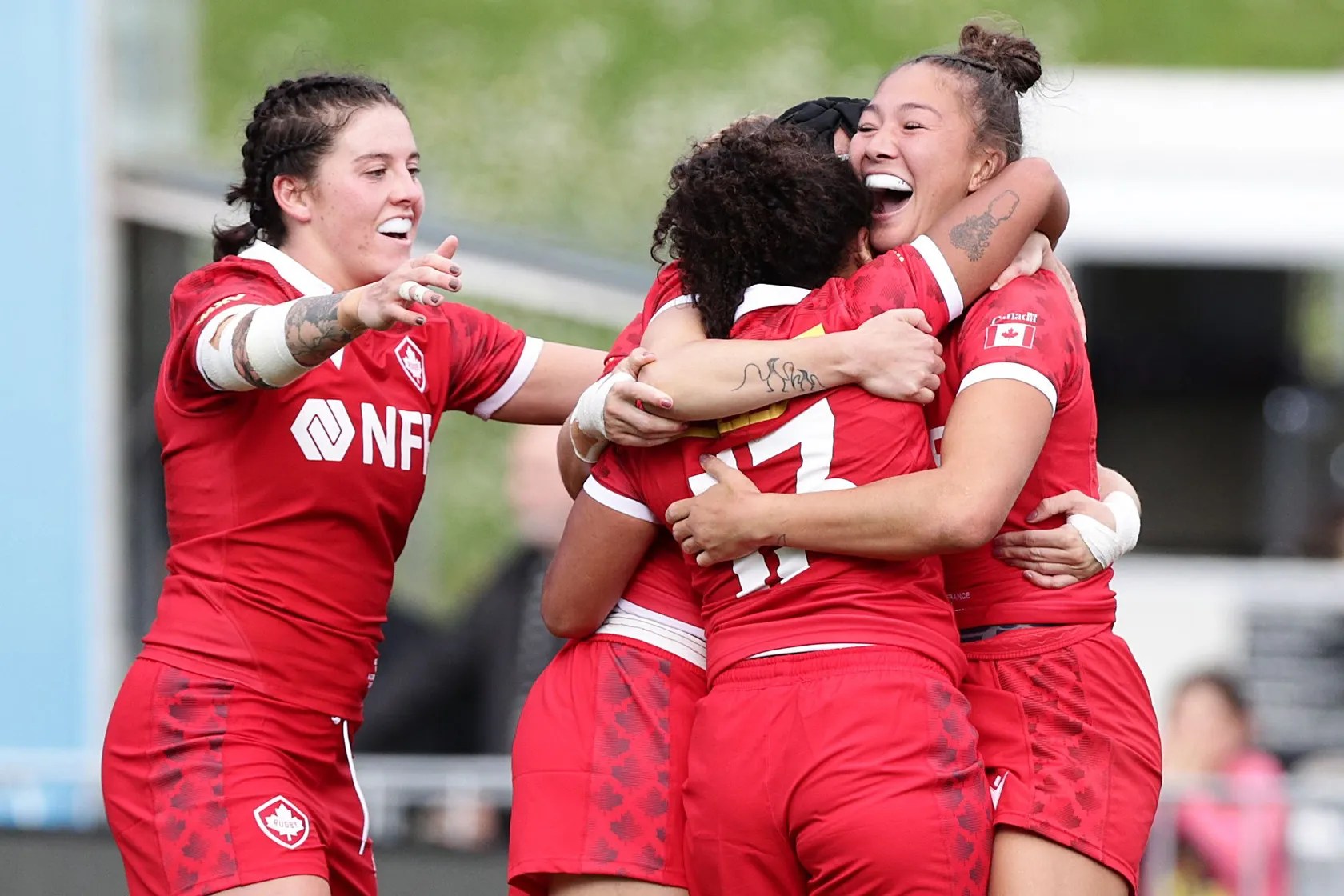
Canadian Women’s rugby continues to provide us all with hope for the future of rugby in this country as well as being a source of genuine pride. Captain Sophie de Goede and her outstanding charges continue to prove that rugby in Canada is most definitely not a lost cause. Canada’s strong second place finish in the WXV tournament sees them maintain their ranking as the fourth best Womens team in the World, and drawing ever closer to France’s third place ranking.
There is still a considerable gulf between Canada and the best team in the world England, as evidenced by Canada’s only loss in the WXV. However, considering that many of our players are playing their club rugby in many of the same professional teams in England that the Red Roses are drawn from, there is plenty to be optimistic about in terms of Canada’s ability to close the gap in the coming years. For example, England Captain Marlie Packer and Sophie de Goede pack down together in the same scrum week in week out for Saracens. Of Canada’s starting XV against France two weeks ago, the entire forward pack plays professionally in England along with Fly Half Julia Schell, Centre Alex Tessier and Winger Paige Farries – in short almost 75% of the team.
Canada started their WXV with a clinical demolition of Wales, and although the Welsh finished at the bottom of the table, they were not exactly pushovers. They were one of the most competitive teams in the Six Nations this year and ran eventual WXV third place finishers Australia extremely close. Our biggest concern heading into the WXV was that Canada, in reality, had played very little rugby since their World Cup heroics last November. They finished a strong second in this Summer’s three game Pacific Four series against New Zealand, Australia, and the USA. They then had a two game series against England in September, which saw them be competitive, especially in the second fixture, but ultimately fall short on both occasions. Still, only five games heading into the type of high-level competition that the WXV at Tier 1 level is rapidly proving to be left us concerned that they may be slightly short on game time come October.
As evidenced by their solid win over Wales, we shouldn’t have been concerned. Their second game against England which saw them take a relatively heavy loss 45-12, did set some alarm bells ringing given that the following weekend they were set to face France who put them to the sword 36-0 in the World Cup bronze medal final last November. Nevertheless, even in the loss against England, there were plenty of positives, and Canada were very much in contention for the first hour. Sadly, they needed to find another twenty minutes at this level, something we can honestly say they did against France a week later.
What has perhaps impressed us the most about this Canadian Women’s team this year is their ability to learn and learn FAST. All the mistakes they made against New Zealand in the second game of the Pacific Four series they addressed to the full against Australia a week later. The same can be said of the mistakes they made in the game against England in the WXV, when they went on to play France a week later. In short, give this team a to-do checklist, and they go out and tick all the boxes, and do it all in the space of a mere 7 days. The handling was crisper, the set piece work was tighter, and their kicking game much more precise for the most part. Still there were mistakes made and against a powerhouse team like France that is to be expected, but once Canada found their groove on the half hour mark they never looked back and from the 44th minute never relinquished their lead on the scoreboard, despite a very determined comeback from the French. A few opportunities were missed that could have extended the scoreline even further, but Canada kept their composure and made sure that all the pressure was on France and not them.
The win against France and Canada’s strong second place finish in both this year’s Pacific Four series and the WXV Tier 1 are significant milestones in helping them to build on the momentum gained at last year’s World Cup. In both competitions, they faced the best in the world and acquitted themselves well. They may have lost against the number 1 and 2 sides in the World this year, in the shape of England and New Zealand, but in both matches, they gave their opponents serious food for thought. This team knows how to win, and that culture and positivity is evident in everything they do, no matter what the numbers say on the scoreboard – in short this is a team that just refuses to give up.
It’s that commitment and never say die attitude which has so impressed us this past 18 months – qualities the Canadian Men’s Team could do well to emulate. That perhaps makes the case all the more pressing that if the Men and Womens programs are competing for limited amounts of funding, then priority in allocating said funding MUST be merit based. On that basis, the Women’s program must take priority – they’ve earned it and deserve it, plain and simple. We were appalled to learn that some of our Canadian Women had to fundraise themselves to ensure their participation at last year’s World Cup in New Zealand. Meanwhile the Men’s team who can count on one hand the number of games they have won in the last four years, appear to be under no such pressure as a seemingly endless succession of losses and mediocre performances are taken as an acceptable benchmark for maintaining the status quo in Canadian Rugby. If you ask us, that’s a red card all year long!
In short, all this Canadian Women’s team needs to do is find the quality of execution needed to finish out games in the final quarter against outfits like England and New Zealand. They have shown us this year that they can do it against everyone else, there is just that little bit extra that’s required for opponents like the Black Ferns and the Red Roses. Like we say, though, this team’s ability to learn from and correct their mistakes is exemplary, as is their togetherness as a unit and a collective belief in themselves and their abilities. We’ve loved watching them play this year and have been immensely proud of their efforts. We can’t wait to see what they can do in 2024 and feel that come the World Cup in England in 2025, they will be seen as genuine title contenders, but in an even stronger position than they were in the 2022 edition in New Zealand. So well done, Ladies, and we look forward to celebrating with you what should be an even more successful year ahead!
Meanwhile over in Spain……………what can we say?

Don’t get us wrong. We genuinely want to sit here and write positive things about Canadian Men’s Rugby. The problem is it’s a bit like being promised a brand new exciting and groundbreaking model of a new car every year only to arrive at the showroom to find that it’s exactly the same as last year’s model, which wasn’t all that interesting to begin with. It’s also perhaps hard to find enthusiasm for a Men’s program that, in comparison to Canada’s extraordinary Womens programme, is a bit like comparing a Ferrari to a Lada. You can get both cars in red, but only one actually has any performance.
Canada’s loss by 42-20 to Spain last weekend in the opening game of the slightly makeshift La Vila tournament in Spain between the USA, Brazil, Canada, and Spain left us feeling more than a little flat. Admittedly, Canada woke up slightly in the second half and played some half decent rugby, but as always with the Mens team, it was far too little too late. What is the point of Coach Kingsley Jones wittering on about positives in the second half when you don’t show up for the first?
Therein lies the problem. Watching Canada shuffle half heartedly around the pitch in the first half with no drive, commitment, or any sense of purpose left a rather bitter taste in our mouths. We simply don’t buy the excuse that Canada hasn’t had much game time this year. While there is some validity to that crutch, Spain hasn’t exactly been pounding the Test pitches this year either. Spain did play five games earlier this year, but only in Rugby Europe (the second tier Six Nations competition) where the only genuine high-level opposition they faced was Portugal and Georgia. They did play Romania as well, but as we witnessed in the World Cup, Romania has been exceptionally poor this year. Canada got to play Tonga twice, which is almost the same. The Spaniards did play Argentina in a World Cup warmup, but that was such a schooling by the South Americans that it almost didn’t count.
As much as we continue to hold the view that the entire Coaching regime under Kingsley Jones needs to be shown the door as soon as possible at the start of this next World Cup building cycle, the players themselves need to take responsibility for Canada’s performances as well. While the Coaching quality may be seriously lacking, the players need to at least show some heart on the pitch. Most of the players looked in the first half as if they’d really rather be somewhere else. At the risk of sounding a lot like Kingsley Jones himself, there were some positives, most notably new number eight Matt Oworu. Unlike many of his colleagues he wore his heart on his sleeve the whole time he was on the pitch, and was one of the few players who genuinely looked like there was a rugby match going on and pride in the jersey actually meant something to him.
While Canada did roll up their sleeves somewhat in the second half and claw back two tries, there is no denying that they never looked like winning that game, especially given the fact that Spain managed to run in a staggering five tries in the first half. Spain, by comparison, looked like they were relishing the task at hand and weren’t afraid to make mistakes and, as a result, were highly entertaining to watch. To be honest, it was a bit like the Ferrari/Lada comparison mentioned above.
There is a strong possibility that Canada will beat Brazil this coming weekend, but let’s be honest, there are no guarantees. However, assuming that they do, what concerns us is that all the failings highlighted in the game against Spain will be swept under the carpet and Jones and his staff will start making bold predictions about the building blocks of a trip to the next World Cup in Australia in 2027. Unfortunately, this will prove nothing. Given the fact that World Rugby, in their misguided wisdom have expanded the competition to 24 teams for Australia, it is now almost guaranteed that no matter how mediocre Canada is, they will qualify. Consequently, a string of wins between now and then against other bottom of the rung Tier 2 nations will give Canada no indication of whether or not the team is actually making any progress to the point where we can once more occupy the top rungs of the Tier 2 ladder – an aspiration that in their present state is nothing more than a pipe dream.
The MLR as North America’s first foray into professional rugby is simply not producing the results at Test level that similar initiatives for Tier Two nations are having in South America and Europe, and we don’t think it’s just a question of money. In North America funding should be much easier to access than in places like Portugal, Spain, Uruguay, and Chile which have miniscule player bases and sporting cultures that are almost overwhelmed by football to the point that there is little if any room for anything else.
In short, we’re tired of the excuses. It can be better than this as our extraordinary women are proving to us every year. It’s time to wake up and smell the coffee burning gentlemen!
So where do the Southern Hemisphere’s big two go from here?

South Africa have been crowned the most successful World Cup competitor as a result of having now got four Webb Ellis trophies locked away in their cabinet. However, all good things must come to an end, and in their case, this golden generation of the last two World Cups needs a major refit. Legends like Duane Vermeulen have hung up their boots, whilst the likes of Bongi Mbonambi, Eben Etzebeth, Faf de Klerk and Pieter Steph du Toit will all be very much the wrong side of 30 come the next World Cup. Furthermore, and perhaps most importantly, will their inspirational Captain Siya Kolisi still have one more big push left in him at the age of 36 in 2027? We’d argue providing the injury gods are kind to him, probably yes, but it’s clearly a gamble.
South Africa will need some major retooling over the next four years, and while there is talent aplenty in the country, we have a hunch that it’s not quite the caliber of this extraordinary group of Springboks who have risen so spectacularly to the occasion in the last two World Cups. There’s a need for some consistency and Plans A,B, and C in the fly half position. There is no clear succession to Faf de Klerk and Cobus Reinach in the scrum half berth. The United Rugby Championship is rapidly starting to produce an impressive looking set of back and second row understudies to the likes of Etzebeth and Vermeulen, but they need plenty of game time over the next four years. However, their front row stocks still look relatively barren for now and there is ongoing confusion as to what South Africa’s midfield pairings should really look like, whilst the backline in general could use some tweaking with an eye to the future particularly at fullback.
As for New Zealand, they lose some big names after this World Cup most notably in the shape of scrum half Aaron Smith and second rower Sam Whitelock, but we’d argue there is enough new and seasoned talent in this All Black squad that will be the right side of thirty come the next World Cup. Add into the mix a new Coaching regime under the tutelage of the most successful Super Rugby Coach in history, the Crusaders’ Scott Robertson, and All Black supporters have every reason to be wildly optimistic over the next four years. When you consider that back rower and vice Captain Ardie Savea, who was without doubt New Zealand’s best player this tournament will be 34 come the World Cup in Australia and probably at the peak of his remarkable prowess and leadership abilities – it would seem that the All Blacks are in VERY safe hands for the next four years.
The only negative we can see is the continuing stagnation of Super Rugby, despite the addition of Pacific Island sides. The competition is increasingly becoming a very one-sided affair in favor of New Zealand. As a result, New Zealand teams only face genuine competition amongst themselves. We’re not holding our breath that the Australian franchises spread too thinly amongst five sides are likely to become that much more competitive over the next four years. Meanwhile, the odd defeat to sides like the Fijian Drua doesn’t really give New Zealand players enough exposure to different playing styles over the long five month Super Rugby season, before the soon to be revised international calendar gets underway in the second half of New Zealand’s rugby calendar. Juxtapose this against South African and European sides who are exposed to a variety of different styles during the course of the Northern Hemisphere club season in the shape of the Champions and Challenge Cups, along with South African, Irish, Italian, Welsh and Scottish sides all playing together in the United Rugby Championship.
This is not an insurmountable challenge for a country blessed with a depth of talent that most countries can only dream about. As shown during this World Cup there is the nucleus of a very dynamic All Black side in the making over the next four years, but they will need to be mindful of the fact that they are not the International benchmark they have been in years gone by. In many cases, the rest of the World has caught up and, in some cases, surpassed New Zealand. The aura around the All Blacks has gone even if the respect is still there in spades. New Zealand is still a side everyone wants to beat, but this new All Black generation will need to embrace the reality of the fact that they are one of international rugby’s elite rather than its focal point of excellence, if they want to keep us all guessing over the next four years.
In the Northern Hemisphere, it’s time to hit the reset button for Ireland and England, while France simply need to make some design changes
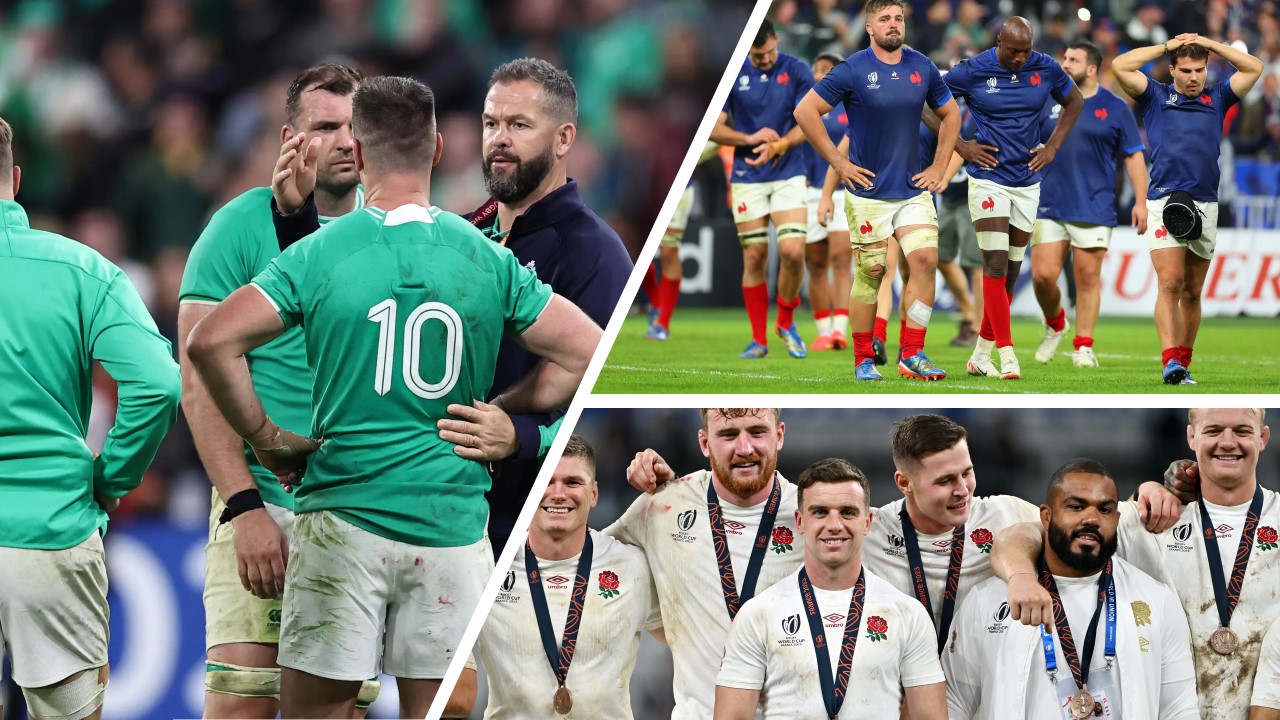
After the elation of the World Cup for some lucky nations and the heartbreak for others, one of the most exciting things after the dust has settled is the opportunity to pick up the pieces and in many cases start with a completely clean sheet of paper, as teams start out on their journey of building for the next World Cup. Of the three Northern Hemisphere countries that found themselves in the top five of the World Rankings after this World Cup, Ireland, France and much to everyone’s surprise including perhaps even their own, England there is cause for genuine optimism and excitement as they look to the future.
For Ireland, the obvious heartbreak and emotional scarring of once again not being able to get beyond the Quarter Final stages on their eighth attempt will need to be dealt with. However, we think it’s a bit different this time around. First of all, although they lost to New Zealand, unlike in other World Cups they put on a display that has earned that Quarter Final fixture in Paris the worthy title of one of the greatest games of rugby ever played. In stark contrast to previous World Cups, Ireland did not exit with a whimper come the knockouts, it was a full blooded arm wrestle lost on the finest of margins right to the final whistle.
Some old heads will likely hang up their boots after this World Cup, with talisman and Captain Jonathan Sexton already having called time on an illustrious career. However, there is a raft of exciting Irish talent waiting in the wings ready to take their place. The argument that a lot of younger players didn’t get the game time they needed this previous World Cup cycle is a valid concern, but in the next four years, this can no longer be an excuse. Ireland have to hit the reset button and hit it hard. They are blessed with depth in every position across the park but it now needs to be fast tracked from day one of this new World Cup cycle, and where it is found wanting new recruits brought into the fold in a timely and supportive manner.
Perhaps the biggest question lurking over Ireland is whether or not Coach Andy Farrell will be with the team for the next four years. His contract is up for renewal midway through this World Cup cycle, with him also being tipped for the Head Coaching job for the British and Irish Lions tour to Australia in 2025. This would necessitate him being slightly less hands-on with Ireland for up to a year. Indications would appear to be that the popular Englishman is keen to stay with Ireland till the conclusion of the next World Cup, and we very much hope for their sake that this will indeed be the case.
Farrell has done a brilliant job with Ireland and is very highly respected and liked by his players and the Irish rugby public in general. In short, Ireland will want to keep his services, and he appears enthusiastic about the prospect of his role with the national side being continued. In our humble opinion, the IRFU should be making every effort to iron out Farrell’s contract extension until the end of 2027 as soon as possible. As everyone knows we are very much against the changing of a Coach midway through a World Cup cycle, and if Ireland are serious about breaking their Quarter Final curse, then this uncertainty needs to be put to bed at the start of this World Cup rebuilding phase and not halfway through it. Do that, and despite the pain of October 14th, Ireland’s future still looks very shiny indeed.
For France, October 15th, 2023, is a day that will live in infamy for them, but it needs to be brushed under the carpet of French rugby history as soon as possible. France should have been in at least the semi-finals, had it not been for a lopsided draw, and some poor decision-making at critical moments in the Quarter Final against South Africa. However, give that loss some perspective. They were in that game all the way and only lost by one point. Admittedly, they lost control of the final ten minutes and allowed South Africa as a result to hold on and claw out what seemed an impossible win. Nevertheless, once France are able to move on, the future looks very bright indeed.
This is still one of the youngest groups of players of any of the top nations, blessed with an abundance of truly remarkable talent. Tighten up the decision-making that tripped them up on a few occasions against South Africa in the Quarter Final, and all of a sudden, you have a team that will be exceptionally hard to beat. Remove the added pressure of playing in front of an expectant and demanding home crowd in your own World Cup, and we have a hunch that France will be a lot more relaxed and composed come the World Cup in Australia in four years time. Having been in France for this World Cup, the pressure on Fabien Galthie and his charges to produce that BIG result was palpable to the point where the weight of possible failure must have been almost impossible to bear for this French team at times. France deflated in seconds once Ben O’Keefe blew the final whistle in Paris on October 15th and the country with it. They were still great hosts, but you couldn’t help but feel that despite the disappointment, a massive weight had been lifted off the shoulders of this young but very talented team.
The majority of this French squad who fell just short of the mark this World Cup will be at the absolute height of their rugby prowess come Australia in four years time, with the vast majority of them still being under thirty or just a hair over it. Scrum half Antoine Dupont will only just have turned 32 whilst Fly Half Romain Ntamack will have just turned 28 along with phenomenal number 8 Charles Aldritt, who will have just had his 30th birthday. If they and many of this French team are this good now, just imagine what they are going to be like in four years’ time with that much more experience under their belts. Meanwhile France continue to dominate the World Under 20s championship, the TOP 14 is considered the best club competition in the World, and it’s hard not to feel optimistic about France’s chances come Australia in 2027. We couldn’t help feeling that as good as France looked for this World Cup there was still a year or two more of seasoning required if they really were going to go all the way and lift the Webb Ellis trophy. That will happen in the next four years, and as a result, the rest of the world has been warned!
England was the complete surprise package of the World Cup. So much so that we have a hunch that even they were quite taken aback by how well they ended up doing. Written off by everyone, ourselves included, they exceeded expectations and then some. Did they play a particularly enterprising or attractive brand of rugby? No, but then, in reality, neither did South Africa at times, and they went on and won the thing. England still may have precious little in the way of an attacking game, but when it comes to grunt and determination and perhaps a healthy dose of sheer bloody mindedness, they were hard to beat this World Cup.
They played a shrewd defensive game at times and used their kicking game to make up for what they lacked in attack. The more they played, the more they started to believe in themselves, and by the end of the tournament, they actually looked like they were genuinely enjoying playing rugby again. As they grew into the tournament, they became more expressive and at times even started to look mildly adventurous by their own conservative standards. Owen Farrell, after some initial wobbles, rose once more to the challenge of the Captaincy and, for the most part, led his charges well. Ben Earl finally provided the edge that England has been lacking at number eight for years, while Ollie Chessum provided the added stability and grunt in England’s second row that his partner Maro Itoje has needed for so long.
Questions now remain for England about the future, and answers need to be found quickly. Owen Farrell is unlikely to be around for the next World Cup, and England’s long-term fly half prospect needs to be settled for the next four years. In short, is it Marcus Smith, George Ford, or someone starting to make waves at club level in the Premiership? England can not afford the Jonathan Sexton experiment at fly half as Farrell will be over 36 come the next World Cup. Some hard decisions need to be made here and made soon. The same applies to the scrum half berth with both Danny Care and Ben Youngs now very much out of contention. England also need to determine what they want their midfield to look like, and Manu Tuilagi is not the answer going forward, whereas the likes of Ollie Lawrence and Joe Marchant, amongst others, are. The front row definitely needs some work, but the back row and second rows are finally starting to hum.
If Coach Steve Borthwick can put all the pieces together in the next four years, and allow England to win by playing attractive attacking rugby in conjunction with their ability to win ugly when they need to and which they have proven rather adept at, then this could be a formidable England team in the making. Despite all the criticisms levelled at him after he took over from the universally loathed Eddie Jones, Borthwick seems like a genuinely likeable fellow who has transformed this team into a group that seems to enjoy playing rugby once more. He seems to have the buy-in and trust of his players and, as a result, in our opinion, needs to be given a fair kick at the can over the next four years. Give him and his team the support, staff, and resources they need, and you could well see England challenging for top honors come Australia, in marked contrast to how they started this World Cup campaign.
England’s roller coaster ride of more lows than highs since that World Cup exit in the Pool stages at their home tournament back in 2015 is now hopefully a thing of the past. Develop some consistency and learn how to play with ball in hand, and England and their supporters could at long last look forward to Saturday afternoons and Test rugby once more.
There is no denying the legacy one of Rugby’s officiating legends, England’s Wayne Barnes, has left on the game – and we’d argue it’s a positive one

We’ll be the first to ashamedly put our hands up and say that in the early days of Wayne Barnes’ career, he wasn’t our favorite referee. We found him a touch pedantic, slightly stubborn and just a tad irritating. Since then, though, the Englishman has firmly worked his way into our favorites club alongside some of the game’s very best. He’s definitely up there with Wales’ Nigel Owens, South Africa’s Jonathan Kaplan, Ireland’s Alain Rolland, and New Zealand’s Paddy O’Brien to name but a few of the game’s greatest. In short, he has become one of the finest and most likable individuals to wear a whistle round his neck in our beloved game.
While all referees make mistakes, especially in the early days of their careers, Barnes has evolved into one of the best in the business. Sure there have been times where we might have raised a few eyebrows on some of his calls, but certainly in the last ten years, we can honestly say that we never found any of his judgements to be blatantly off the mark.
The fact that in the last few years whenever we’ve seen Barnes’ name pencilled in as the man in charge of a big Test we’ve always breathed a sigh of relief says a lot about the man and the legacy he leaves behind. Was he perfect – no? Was he fair and earned the respect of the players he officiated over – absolutely. Furthermore, we appreciated how he made it a point of communicating with French players in French and even started to get rather handy at Spanish with teams from South America. He made it crystal clear what he expected from the players he refereed in terms of standards, and we also found that he excelled at allowing games to flow and his style suited it. Games he was in charge of tended to have momentum and rarely degenerated into tedious slugfests of endless scrum resets and technicalities. In short, he allowed players and games to breathe.
Consequently we are very sad to see him hang up his whistle for good, and as mentioned in last week’s missive we have shared the collective distaste for any abuse that has been directed at him or his family over the years. Being a referee in rugby is a largely thankless task, but one that Barnes rose to with class, grace, and a touch of panache. While he may no longer be the man in the middle on Saturday afternoons, we are delighted to hear that he will continue to use his legal background to campaign against player and referee abuse in our sport, and hopefully help develop protocols to put an end to the disturbing rise in social media attacks we’ve seen in recent times aimed at officials and players alike.
So we wish “Barnesy” a fond farewell and owe him some heartfelt gratitude for his service to our game over the years, and which we are delighted to hear that he seems set to continue off the pitch. To Wayne Barnes and his family all the very best for the future and we sincerely hope you’ll continue to be the larger than life presence in our game you’ve been for all these years – we are certainly going to miss you!
Well, that’s it for this week, folks. Till our next missive take care and lots to look forward to in the coming months as we start to cast our eyes over the horizon to a Land Down under in four years’ time.
 The Lineout