Well we have to say it last week wasn’t what we expected. For us, it was slightly disappointing on some fronts as a game we were eagerly anticipating ended up being one of the biggest anticlimaxes of the year as the Lions breezed by an invitational Aus/NZ XV. It highlighted to some extent the weakness of a lot of the games leading up to the first Test between the Wallabies and the Lions this weekend as symptomatic of Australia’s lack of player depth. Wallaby Coach Joe Schmidt is faced with ongoing concerns as another of his star players looks set to miss the all-important First Test. Meanwhile, the Lions look to be well settled and ready for battle despite some of their own ongoing injury concerns.
Canada’s Men once again struggled and made us question what is the value of the MLR, as South of the Border the USA also fell to Spain. In New Zealand, as we suspected, they would in the Second Test the All Blacks rubbed France’s face in the dirt over their decision to bring an inexperienced squad to the Land of the Long White Cloud. Argentina simply couldn’t turn their ambition into execution against a very well drilled England team, which highlighted that after France, England are developing a very solid body of player depth at just the right time in this World Cup cycle.
Fiji taught Scotland some very uncomfortable lessons, though why any Fiji win over a top Tier side is still considered an upset remains a mystery to us and rather disrespectful. Fiji are firmly camped in the top ten list in the World Rugby rankings in case that has somehow escaped the rugby media’s attention and also gave Australia the fright of their lives only a week earlier. As expected, Ireland blew past a hapless Portugal in what, in reality, was sadly a rather meaningless encounter and taught neither side anything particularly useful about where they are in terms of development. Lastly, South Africa using some debatable tactics at times, which we’ll unpack down below, blitzed past a confused and disjointed Italy.
On the plus side last weekend, Canada’s Women got a gritty win against a tough South African Springboks Women’s outfit in Gqeberha (Port Elizabeth). Canada fielded a much less experienced side than in the opener in Pretoria and while Canada’s performance lacked a lot of their usual polish at times, it was an excellent opportunity to test some of the younger players in a tough environment. Despite the challenge, they still managed to emerge victorious on the road in a difficult encounter and win the series. The added benefit of the leadership group on the pitch to steer some of the debutants came to the fore when needed most. It may not have been pretty at times but was invaluable experience ahead of the World Cup, which is now only 38 days away.
So let’s get into what caused us to stare glumly at times into our pints to try and work out the portent in the dregs at the bottom.
The Lions look rather sharp to say the least but has the quality of the opposition really tested them as Wallaby Coach Joe Schmidt scratches his head on those First Test selection calls as the Medics keep taking away his options?

After watching the Lions put another almost 50 points, this time unanswered, past a rather pointless and ill prepared combined Aus/NZ XV, a game we’d actually been looking forward to given some of the assembled talent in it, we couldn’t help feeling a sense of relief. To be brutally honest, none of these Lions games leading up to the first Test against the Wallabies this weekend have been particularly inspiring affairs. Sure, there have been some mesmerizing displays of skill from some of the Lions players such as England’s Henry Pollock, but overall, they have been totally one-sided and rather meaningless events. While the purpose of them is primarily to warm up a group of players who have never played together on Tour before, there still have been some epic clashes on previous Tours. Remember that thrilling battle between the Brumbies and the Lions on the last Tour to Australia in 2013, which saw the Canberra outift secure a historic win?
Sadly, none of the buildup to the first Test has had any of that sort of character or sense of meaning other than a fairly positive series of one-sided runs for the Men in the Red jerseys. Admittedly, it’s a highly professional Lions squad containing perhaps some of the finest talent ever assembled in the famous jersey. Furthermore, player depth in Australia, as we have sadly been lamenting these past few months, is nowhere near what it was 15 years ago. Games that have been a bit closer, such as the surprising performance from the Waratahs, have been more down to the Lions simply having an off day for the most part than actual Australian razzle dazzle. Shorn of the vast majority of their Wallaby A-Listers as Wallaby Coach Joe Schmidt, for good reason, given his limited player base, simply couldn’t afford to risk them, the pre-Test games have lacked any genuine intrigue or buzz to them. Last Saturday’s cobbled together Aus/NZ invitational side was just that – a ramshackle purposeless outing.
The Lions are now well prepared and know their systems, whereas it is really hard to guage where the Wallabies are at with very few of those likely to run out against Andy Farrell’s charges on Saturday in Brisbane having had any exposure to the Tourists over the last three weeks. Consequently, we fear there is a potential hiding in store for Joe Schmidt’s charges wearing the fabled Green and Gold this Saturday. A 50 point walkover by the Lions will simply raise the question marks surrounding whether or not Australia still remains a viable touring destination for the Lions, and furthermore plunge Australian rugby into an even deeper identity crisis than it already faces in terms of its future in the Land Down Under’s sporting landscape.
The injury question marks surrounding Wallaby Coach Joe Schmidt’s selection choices for this Saturday are daunting. He lacks a genuine, tried and trusted fly half and playmaker, and his back row, despite the talent of Harry Wilson and Fraser McReight, suddenly becomes a lot less of a threat without the superpower abilities of Rob Valentini. Andy Farrell, by comparison, Schmidt’s opposite number and essentially former pupil when he was Ireland Coach has no such problems, especially in his forward stocks and in the 10 jersey. In contrast, Farrell seemingly has an endless supply of quality replacements all holding Qatar Airways standby tickets while Schmidt’s options appear to be growing thinner by the day.
However, as we used to say when Schmidt was Ireland Coach, “in Joe we trust”. This is one of the smartest rugby brains out there in modern Test rugby and one who excels at such challenges. If anyone can prove all the critics wrong and turn this Tour into a resounding nailbiting success, then Joe is your man. We can’t wait to find out on Saturday despite some of our trepidation. So put away the negatives, focus on the positives, and let the real games begin!
Australia vs British and Irish Lions – Saturday, July 19th – 6:00 AM (Eastern) – DAZN, Premier Sports Asia and Stan Sport Australia (live and on demand)
We knew it would happen, but the All Blacks taught France’s youngsters a rather rude and painful lesson in the second Test, and with the Series sewn up is there even a chance for the Third and Final Test to be a meaningful contest?
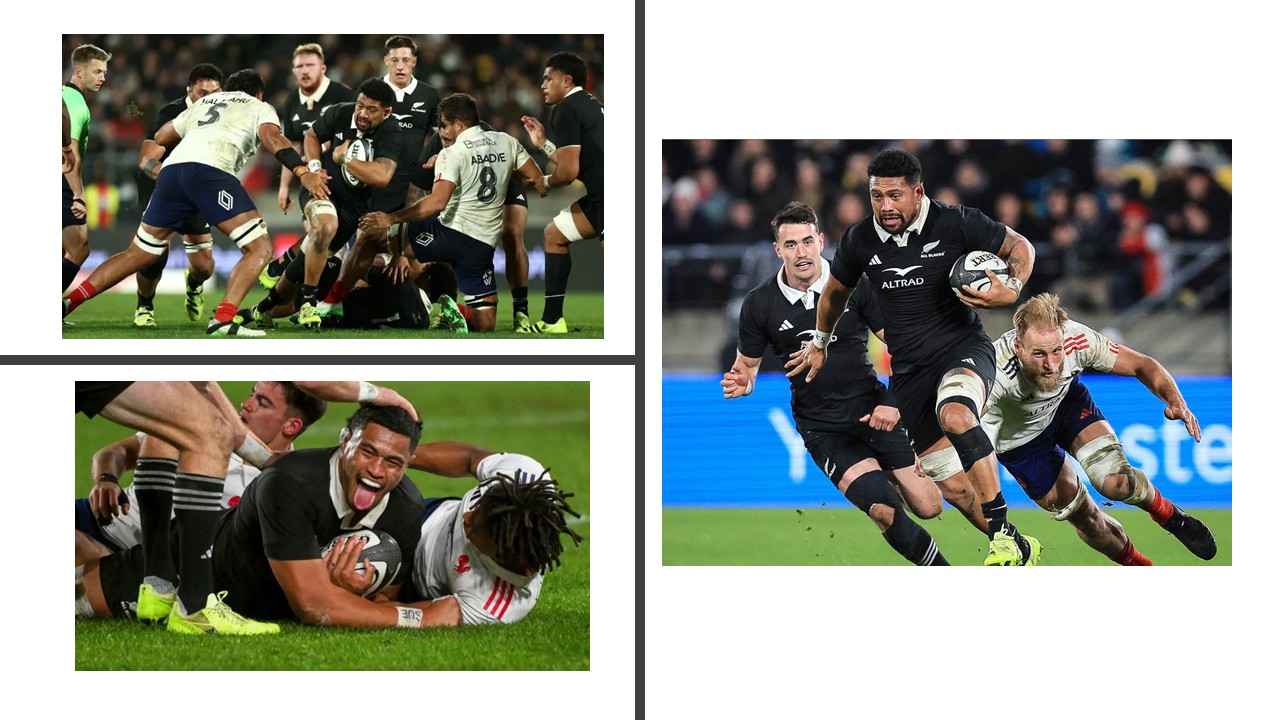
Well you knew it was coming, some sort of humiliation of France by an All Star All Blacks squad was in the pipeline, especially as New Zealand felt genuinely affronted and aggreived by the perceived lack of respect shown by France in the squad they selected. We’ve already beaten that horse to death so won’t continue, but we had to admit that we were surprised and a tad irritated by Fabien Galthie’s selection for the second Test which could have set up a Series decider this weekend. As it is all France will be playing for on Saturday is pride, and with the Series gone and the end of a interminably long season and the exhaustion that goes with it, will whatever French players chosen simply put up the white flag and focus on the long flight home and their short summer break?
To be honest, it would be hard to blame them if they did. We struggled to understand why French Coach Fabien Galthie chose to make such wholesale changes in last weekend’s Second Test to a team that had given an admittedly rusty All Black side a genuine run for their money. France were simply outclassed, outplayed, and overpowered last weekend by an All Black side with a point to prove and a desire to put France firmly in their place after their perceived affront to New Zealand rugby.
It was a positive and assured performance from New Zealand that left very few questions unanswered on where this All Black side is at in their second year under Coach Scott Robertson and where they are headed. For us, the standout performer, though, was back rower and Captain Ardie Savea. Ever since his Test debut for the All Blacks in 2016, we’ve been mesmerised by this ultra dynamic back rower. We’ve also felt that the Captaincy should have been his since the retirement of Richie McCaw after the 2015 World Cup and the experience Savea had gained by the next installment in 2019. His work rate and stamina have to be seen to be believed, and just his sheer presence on the pitch is such a motivating force to the rest of his teammates. An epitome of sound judgment and respect for both the officials and his opposition, he has been a credit to the game ever since he first donned the famous black jersey. In short, one of the true legends of All Black rugby and a player who would feature in our first XV every day of the week every year. Need we say any more?
As for France, we simply don’t know what to expect from them in this third and final Test in Hamilton. At least it’s not Eden Park where the All Blacks seem unbeatable. Although France is the last side to beat New Zealand at the hallowed ground of Eden Park, it was 31 years ago in their final Test of a very successful Tour. Furthermore, the side that ran out against New Zealand that day was literally a who’s who of French rugby at the time. Do any of these legendary names ring a bell? Jean Luc Sadourny, Philippe Sella, Emile Ntamack, Thierry LaCroix, Abdelatif Benazzi, Olivier Roumat, and Christian Califano and that’s just a few as the list goes on. The calibre of the All Blacks team likely to face France this Saturday in Hamilton is equal to this fabled 94 French side, but the runouts for this rematch 31 years later wearing blue (or white as seems to be the case on this Tour) are unlikely to match up to the same standard. There is some huge potential there make no mistake, and the possibility of an all out edge of your seat do or die affair is there, especially if the French play with the commitment and resolve they showed in the first Test.
However, sadly we fear that with the Series sewn up it’s now the end of a long hard season for all the players in blue and whatever happens on Saturday it won’t change the fact that ultimately France came with good intentions but were ultimately shown the door by a much stronger side. We hope it won’t be the case and that Fabien Galthie and his charges have one last big surprise up their sleeves and a desire to repeat the history of that famous day 31 years ago. It’s a massively tall order for an inexperienced but exceptionally talented side, but imagine the headlines the next day if they pull it off. As for us, we’ll probably need the rest of the summer to get over what would be one of THE upsets of the decade. So, as always, we’ll put our doubts aside and hope for one of those incredible games that these two sides have a habit of producing when we’re all least expecting it.
New Zealand vs France – Saturday, July 19th – 3:05 AM (Eastern) – TSN+, Premier Sports Asia, Stan Sport Australia and FLO Rugby (live and on demand)
Canadian Men’s Rugby…..!??? Enough of the excuses, and is the MLR doing more harm than good?

Don’t get us wrong. We desperately want to be positive about Men’s Rugby in this country – we really do! Sadly though as enthusiastic and as proud as we are of our truly remarkable Women, we struggle to feel the same way about the Men’s programme, and it’s getting harder every year. We watched Saturday’s game in Edmonton with a serious sense of trepidation and a glass of something stiff close by in case it all got too much for us, which ultimately it did.
Even with a new man in charge in the Coaching Box, Australian Steve Meehan, an alarmingly familiar pattern was on display in Saturday’s match. Poor execution, almost nonexistent defence, and a team looking seriously unfit and out of shape, even allowing for the 25C heat and 63% humidity, were what struck us the most about Canada’s performance against Belgium. Contrast that to the Belgians who despite the Canadian commentary team of Gareth Rees and Nathan Hirayama’s boundless enthusiasm and constant assertions that Belgium were borderline dead on their feet seemed to be coping far better with the pace of the game and the conditions than Canada were.
The point kept being made that this was a young, relatively inexperienced Canadian team. However, Belgium is still not exactly a powerhouse of International Rugby, and they seemed able to cope with anything Canada threw at them. Of the five seasoned Internationals on the pitch for Canada it was only Captain Lucas Rumball, who, as he always does, appeared to be putting in the effort required to motivate the younger members of this squad. We did feel that his disallowed try should have stood, and the neck roll he received from a Belgian player later in the match should have resulted in a yellow card. However, even if those calls had gone Canada’s way, we simply would not have won that match, so sadly, it’s pointless bemoaning them. In short, none of it was convincing, and as for that defense, we are actually unsure if anybody on the Canadian team are aware of what the word actually means.
We appreciate this all seems incredibly harsh and borderline unpatriotic but after years of trying to build this team up we have run out of excuses, and the team should approach their next match against an ominous looking Spain who just beat the USA last weekend, with the same attitude. Coaching aside, this team needs to step up as one and take responsibility for an appalling track record since 2015. The excuses simply have to stop!
In looking at Saturday’s performances by both Canada and the USA, we are really starting to wonder if the advent of North America’s first professional league the MLR is actually taking rugby backwards in terms of results for both Canada and the USA. The USA’s track record since 2015 isn’t much better than Canada’s, and it’s interesting to note that for the most part since the inception of the MLR in 2018 the results for Canada and the USA have been increasingly lacklustre and the wins few and far between.
For Canada, who have played 52 Tests since the start of the MLR, they have lost 36 and only won 12, and the majority of those wins are pre COVID, making the last four years particularly bleak. For the USA, of the 50 matches they have played, the record is a bit better, having drawn one and won 28. However, once again, the win rate has dropped off dramatically post COVID. Of the post Covid era of the 26 games the USA has played since COVID, they’ve managed 13 wins, while of the 24 games Canada has played in that period, they have only managed 7 wins.
Before the MLR, a small but critical number of Canadian players were getting experience overseas in places like England and France but since the advent of the MLR that has dried up to the point where it is literally nonexistent. While the MLR may be enjoyable, there is no denying that its quality is by international standards relatively poor. Contrast that with Super Rugby Americas in South America, where many of the players go on to win lucrative contracts in Europe and even the big leagues like the French TOP14 and the Gallagher Premiership in England. Many of the Belgian players who taught the Canadians some valuable lessons this weekend ply their trade in France’s highly competitive PRO D2 and D3 leagues. Furthermore with no Canadian teams now in the MLR and our players having to play in American teams, we worry that as the commercial interests in the US seek to make the game more attractive and flashy to a sports saturated American public, the preference will be to bring in overseas “project” players from the South Pacific and get them to qualify for the Eagles through the residency clause at the detriment of home grown players in both the US and Canada.
Contrast this to Canada’s Women’s Team, most of whom are playing overseas in England and France and look at how successful Canada’s Women are on the International stage, currently ranked as the second best team in the World heading into next month’s Women’s Rugby World Cup.
In short, we are just not seeing the benefit of the MLR and what it is doing for Canadian Rugby and are slightly concerned about the direction the league is potentially heading in, which likely would have little or no benefit to the development of a healthy and vibrant rugby culture in Canada. It may ultimately take rugby in the USA in a positive direction especially as they look to host the World Cup in 2031 even though we have our doubts, but for us here in Canada we’d argue it’s just not working.
We’d argue that a return of an annual competition like the Americas Rugby Championship which featured teams from North and South America a bit like the Southern Hemisphere’s Rugby Championship or Europe’s Six Nations would be hugely beneficial. The current Pacific Nations Cup featuring Fiji, Japan, Canada and the USA is simply not a level playing field and both Japan and Fiji are miles ahead of us with Fiji’s participation in Super Rugby and Japan’s extremely competitive and popular domestic league that pulls in financial resources that the MLR can only dream about and packed stadiums.
The Men’s game in Canada is currently in freefall and we fear for the result against Spain this weekend and further humiliation at the end of the summer in the Pacific Nations Cup, which could ultimately prove irreperable to the game here. The Women’s game is very much alive and well, but the Men’s game is on life support and looks set to enter a permanent coma if some drastic action is not taken sooner rather than later. Even with an expanded World Cup in 2027 of 24 teams as opposed to the usual 20, the chance that Canada will once again fail to qualify in their present state is a distinct possibility.
So we’ll be waving our little Canadian flags on Friday as we peer nervously over the top of the bar at the TV, hoping we don’t have to look away too often.
Canada vs Spain – Friday, July 18th – 9:00 PM (Eastern) TSN 2 and TSN+ (live and on demand)
By contrast, Canada’s Women get the job done once again in a tough encounter that had plenty of value for their World Cup preparations

It wasn’t a spectacular win and at times some of Canada’s younger players looked to be struggling with a genuine exposure to the rigors of Test Rugby, but Canada’s outstanding Women completed an important Series Win 2-0 over South Africa in Gqeberha (Port Elizabeth) last weekend. Canada fielded a team lacking a lot of big Test experience while South Africa upped their game considerably after imploding against Canada the week before in Pretoria. Gradually, though, as the match wore on Canada began to assert control and the seasoned heads in their ranks like Tyson Beukeboom helped settle the nerves and get the team focused on the job at hand.
In short, Canada still walked away with a solid 33-5 win, with their younger charges having been pushed hard at times. Canada led at the half-time break 14-0, but their customary execution and precision was lacking at times. In the opening 25 minutes of the second half, they struggled to assert themselves on a determined albeit error strewn but very enterprising Springbok side. However, the return to the field of the outstanding Sophie de Goede after a year away from the game due to injury for the final quarter and some outstanding leadership and motivation from veteran Tyson Beukebom in the Captain’s role saw Canada run away with the game in the final fifteen minutes. Ultimately, Canada looked fit and able to last the distance, unlike the South Africans who were clearly battling with having to constantly play catch-up rugby.
Karissa Norsten made her 15s debut on the wing and scored a fine try on the 55 minute mark, and her colleague on the opposite wing Krissy Scurfield finished off the day’s scoring with an exquisite break and dot down in the corner. Canada will want to look at the fact that they struggled at times to impose themselves on a team ranked much lower than themselves but in terms of a developmental exercise and preparation for the World Cup it has been an excellent experience for the squad especially those thin on International caps.
For the most part Canada emerge from a tough tour injury free, though we have to confess feeling some genuine alarm and concern for second rower Laetitia Royer who went off towards the end of the first half with a nasty looking shoulder injury. Royer is such a key part of this squad and vital to Canada’s World Cup ambitions, so we hope that it’s not a long-term issue. On the plus side we were delighted to see former Captain Sophie de Goede make her return from a serious injury and get 22 minutes on the pitch with no apparent ill effects from her long layoff, given how important a role she has played and will play in this team’s development and World Cup campaign.
Canada now take a well-earned break before their final two warmup games before their first World Cup match in York against Fiji next month. They will face the USA in Ottawa on August 1st, so if you’re in town ring fence the day and make sure you get out to TD Place Stadium and give our Women a fitting send off to their final warmup game in Belfast a week later against Ireland.
We are under no illusion that despite the promise this team has, the World Cup will be a whole different beast that will test this extraordinary group of Women like never before. France and New Zealand will be exceptionally difficult prospects and if Canada were to get past either of them and find themselves in a Final against the hosts in the shape of a seemingly invincible England, then the challenge will be enormous. Like we’ve said all along though the self-belief, commitment, and unity of purpose in this team is definitely special. It may be a mountain to climb, but this group will hit the slopes as probably the most well prepared side in Canadian rugby history in either the Men’s or Women’s game!
You can’t fault Springbok Coach Rassie Erasmus for thinking “outside the box,” but some of it really does push the boundaries and is in danger of putting his team in the spotlight for all the wrong reasons

Love him or hate him, it’s hard not to admire Springbok Coach Rassie Erasmus. He is to Rugby innovation what Thomas Edison was to electricity and mass communication. While he has often sought to enrage and confound rugby’s officiating bodies by his actions, there is no denying that his understanding of the rules and laws has helped him to define the sport’s grey area’s and possible legislative loopholes.
South Africa’s one-sided thrashing of a bewildered Italy on Saturday, 45-0, was a prime example. Italian Coach Gonzalo Quesada was visibly upset by the tactics employed by the Springboks, and his concerns have some justification. On the other hand, Erasmus wasn’t breaking the rules per se he was just bending them to allow his side to exploit an advantage that benefitted the way they choose to play the game. In the one instance we feel you have to admire the thinking behind it and it’s rugby lawmakers who either have to tighten up the rules to put an end to it or accept that it is a legitimate play. In the second tactic employed on Saturday, though, we have to beg to differ and feel that not only was it blatantly illegal, but cleverly employed to confuse referee Andrew Brace. There was an element of skullduggery to it that left a foul taste in our mouths and which smacked of unsportsmanlike behavior.
So what’s all the fuss about, you ask? In exhibit one, we feel that this needs to get stamped out, and it’s simply unsportsmanlike. On the initial kickoff fly half, Manie Libbok blatantly gives the ball a simple kick that dribbles off his foot and is never in a month of Sundays going to go the mandatory ten meters. The lawbook clearly states that, in that case, a scrum is required with the feed going to the opposition.
So what’s the problem with that we hear you ask and why would Italy be so upset? South Africa knew they had complete dominance at scrum time and would be able to win back possession and set up a setpiece play from the halfway line rather than having to contest Italy either running the ball or attempting to kick it into the Springboks’ own half on receiving the ball from the kickoff. Furthermore, to add insult to injury Center, Andre Esterhuizen is clearly in front of Kicker Manie Libbok when the kick is taken, which is also against the rules. The whole thing just smacks of the Springboks simply laughing at the rulebook and comes across as rather poor sportsmanship. So surprised was referee Andrew Brace by the blatant lack of an attempt at a ten meter kick that he didn’t even notice Esterhuizen in an offside position, which should have been a penalty to Italy. Ultimately, Italy won a penalty off the scrum so the Springboks’ skullduggery ultimately didn’t pay off, but it was intentional and a blatant attempt at exploiting and twisting or even ignoring the rulebook to your advantage. For want of a better expression, “it just wasn’t cricket” and should have been sanctioned as such.
In exhibit two, though, you can’t help admiring Erasmus’ clever interpretation of the rules and how his side could use them to their advantage. At present, there is a rule trial likely to become law, which bans prebound wedges in open play. On Saturday, South Africa cleverly exploited the current loophole in the rule and the fact that as a trial law, it got overlooked by the officials. In essence, it’s saying you can’t form a prebound pod and then use it as you would a lineout where a player is lifted into the air to catch a pass. As the player is now bound and being lifted, the opposition can not lift or tackle him as this is deemed as interfering with a player in the air or worse, still collapsing a maul. On this one, we find ourselves on the fence. In short, putting aside the vagaries of the law as they exist now, it’s a brilliant tactic whether you like it or not and clearly gives you an advantage and buys you some time which a standard ruck simply wouldn’t allow you. To be honest, although it’s perhaps pushing the boundaries a bit too far and essentially taking liberties, there is a certain degree of ingenuity to it that has to be admired.
Whether you like Erasmus or not, you have to admire the man’s ability to look at the game and work with or around the existing laws. If he were a lawyer you’d definitely want him on your team, and as a tactical Coach on a rugby pitch his ability to see unorthodox opportunities when they present themselves is rather unique to say the least. You may not like it, but you have to admire it. So, cut out the blatant disregard to the rulebook on the kick-off tactic, but maybe the lawmakers have to look at the rules around prebound pods and lifting a player. It does add an interesting element to the game provided there is an opportunity for the opposing side to legally contest it, which at the moment doesn’t exist giving the team using the tactic a technically unfair advantage.
Oh Rassie, you’ll always find a way to keep things interesting, won’t you! As one of the most successful international Coaches of all time, he’s clearly a loveable rascal who revels in adding some spice to our game and making us ask ourselves how the game should develop. He’ll keep us guessing till the final whistle and his beloved Springboks will never be without a trick or two up their sleeves. It’s not the first controversy he’s sparked, and it won’t be the last, but boy, does it make for some good debate over a post-match pint!
Well, that’s it for this week, folks. Enjoy what should be a top weekend of rugby even if your viewing schedule won’t be as busy as it has in the last fortnight!
 The Lineout