As this weekend marks the halfway point in this year’s Six Nations, it is no wonder that it is the sole focus of this week’s missive, and what a tournament it’s been so far! However, as always, at this point, some big questions are presenting themselves. First and foremost, can anyone derail the seemingly inevitable French Grand Slam Express? Italy will no doubt give it a go in Lille this Sunday after scaring the living daylights out of Ireland in Dublin last weekend. Nevertheless, it’s a tall ask. Can Ireland finally get their rather shambolic act together against an England side that received their now traditional Calcutta Cup wake-up call in Murrayfield last weekend? Scotland should have no problem with a Welsh side that, despite the rather unflattering scoreline in Cardiff last weekend against France, showed an abundance of heart and, dare we say it, a definite sign of improvement? In relation to the Scots, is the Calcutta Cup their one-off traditional moment of Six Nations glory, or can they maintain its momentum for those all-important final two fixtures against France and Ireland and, as a result, finally have a campaign to write home about?
As you can imagine, there were plenty of rather animated talking points over some very frothy pints these past two weeks. As we mentioned before, we generally find the Six Nations in the year before the World Cup to be the best of the four-year cycle leading up to the global showdown, and so far this year’s edition is living up to expectations. England and France remain the front-runners, though with the final fixture of the tournament between them in Paris, we’d argue that fortune favours the colour blue this year. Meanwhile, the Lineout’s collective underdog favourite, Italy, has given us plenty to cheer about, and as a result, the colour blue is our theme of 2026. What the tournament has shown, however, more than anything, is that international rugby is now so competitive that, regardless of the standings, any of the top ten nations can beat each other on any given Saturday. It may not necessarily happen, but the potential is certainly there.
That assertion may be pushing the bounds of credibility when it comes to Wales in their present form. Still, they only need Scotland to have one of their classic and well-documented lapses in concentration this Saturday in Cardiff. If the amount of heart on display last weekend against France comes to the fore once more, with a bit more emphasis on execution, the Welsh could surprise us all. Ireland is quite frankly a bit of a shambles at the moment, which pains many of us who hold the green cause close to our hearts, but just like Scotland, can they find the emotional exlixir that always fires them when playing England to get them over the significant speed bump that is Twickenham this Saturday? Let’s face it, Italy has a history of catching France napping, and the last time they met in Lille, it was a decidedly uncomfortable affair for les Bleus, and don’t get us started on that Azurri scrum…. what a thing of beauty!
So many questions, so without any further ado, let’s get stuck into it!
England and Ireland have MASSIVE points to prove at Twickenham this weekend in a fixture bubbling with emotion for both!

First of all, let’s get the elephant out of the room on this one. We, like many people, were appalled by the internet trolling that took place last weekend following Ireland’s scrappy win over an extremely good Italian side, targeting primarily Irish fly-half Sam Prendergast, but also the racist abuse of Edwin Edogbo, who made his Test debut for Ireland last Saturday. Having spent a great deal of time in the Emerald Isle amongst Irish rugby fans, as well as some of us having hardcore Irish sympathies and allegiances when it comes to matters of the oval ball, we know that 99% of the Irish rugby public are like the rest of their countrymen, some of the finest people on the planet. Irish fans are enthusiastic in victory but always respectful in defeat, marvellous hosts and not ones to apportion blame, so we were deeply saddened to see a group of vicious internet clowns who, in reality, probably know very little about the sport spout such vitriol. We know they are an unpleasant minority and not unique to Ireland – sadly every country has them, but we here have absolutely no truck with them as we’re sure you don’t!
Unfortunately, Ireland had a bad day at the office last weekend and in all reality were lucky to come away with the win. Had Italian winger Louis Lynagh’s second-half try not been adjudged to have come from a forward pass, then we may well be writing a different missive this week. Italy, to their credit, did not bemoan this lost opportunity, and their exemplary Captain Michele Lamaro took time out after the game to praise the job done by the first-ever female referee for a Six Nations match, the outstanding Hollie Davidson. To Davidson’s credit, her on-field decision was to award the try, but the inevitable and often controversial meddling from the TMO box forced her to change her view of the matter. We won’t get into the debate on this one, as there are plenty of articles on the laws of physics and that pass from Menoncello to Lynagh; suffice to say that we think Davidson made the correct decision initially – enough said! As to whether it would ultimately have changed the result, that is water under the bridge and neither here nor there moving forward, as far as we’re concerned.
As for Ireland themselves heading into the Twickenham cauldron against a wounded and thus twice as dangerous England, they know they are a long way off the mark at the moment. Contrary to what Internet trolls may think in their dark and miserable subterranean refuges, we don’t think the problem can be attributed to any one individual. Ireland as a team just isn’t functioning right now. This may not be helped by the ongoing indecision about who their fly-half will be going forward, but it is definitely not the primary reason. Ireland had a style of play that was highly effective and suited them and many of the key players of their golden era from 2018 to 2023. Since then, everyone else has figured it out and learned to counter it, while Ireland has seemed reluctant to develop the depth it needs in the International Test arena.
Consequently, Coach Andy Farrell has made a series of changes to the team bound for an exceptionally challenging assignment at Twickenham. Perhaps the most talked about change is the return of Munster fly-half Jack Crowley to the starting fly-half berth and the complete absence of his Leinster colleague Sam Prendergast. While it must be said that Prendergast’s performances in Ireland’s first two games of this Six Nations campaign have been less than stellar at times, it is not because he isn’t a quality player; it’s more that at the tender age of 23, he is still very much learning his trade at Test level. To not undermine his confidence, we are very much in favour of him developing his straps at club level first, and let’s face it, life at Leinster will make anyone drink from the firehose, given their standing in European competition. However, at this stage in his career, he is simply not an all-round Test fly-half, but given time, we are sure he will get there. Let’s face it, the legendary Johnny Sexton only really made the Irish 10 jersey his own at the age of 27.
Contrast that with Jack Crowley, three years his senior, who has been given the nod to start this weekend at Twickenham in the fly-half berth. As anyone who reads our musings over the oval ball regularly knows, Crowley has been our preferred choice for Ireland at 10 since Sexton’s retirement at the conclusion of the last World Cup. Having said that, we accept that Crowley has had good days and bad days in the green of Ireland, and his recent form at Munster tells a similar story. Once again, though, this is not to detract from his abilities as a player or value to the Irish setup, both of which we think are immense. We do think that, after being the fly-half who helped Ireland secure their first and only Six Nations title since the last World Cup, his almost unceremonious dumping after it in favour of prodigy Prendergast dented his confidence rather alarmingly, and that takes a while to repair. However, if he can assert the kind of authority from the bench he showed last week in Ireland’s uncomfortable arm wrestle with Italy, then his teammates should feel confident that the first 60 minutes will ensure Ireland are active participants rather than the idle bystanders they seemed to be in the first forty against Italy last weekend. Is he Ireland’s all-court fly-half at the moment? No, but he is definitely the closest thing they have to the finished product, and, like Prendergast, he can get there. For Ireland, it’s not that they don’t have quality fly halves; it’s more an issue that they simply haven’t been managed and developed all that well since Sexton’s retirement.
As for England, we found the calls for George Ford’s head in the ten jersey after the loss to Scotland last weekend equally distasteful and borderline ridiculous. Did Ford have a good game against Scotland? No, it wasn’t one of his better games, but does that mean that all the progress he has helped this England side achieve over the last year is null and void? Absolutely not! While in the past one could argue that, despite his obvious skills, Ford allowed England to play only one type of game, and as a result, they were rather one-dimensional. Unfortunately, he did seem to lapse into that style of play again last weekend at Murrayfield, but we’d argue he’s both aware of it and capable of change. In our humble opinion, and certainly based on his performances last year in Argentina and in England’s November series, he is now the all-court player England needed him to become, and in terms of steady heads guiding the ship, few can hold a candle to him in that regard.
Consequently, he retains his place as England’s starting fly-half for what is likely to be a feisty and combative encounter with Ireland this weekend. Ireland, if they manage to organize themselves properly on Saturday, will put England’s playmaking axis under enormous pressure, and we’d still argue that Ford is the man to keep England’s contingent focused on the task at hand. While the two Smiths, Marcus and Finn, have plenty of ability to create opportunities for England, if the wheels start to fall off under pressure, the Men in White become disorganized very quickly. England will want to keep Ireland away from the touchlines, as not doing so against Scotland caused them all kinds of headaches. While the Irish may not have the kind of strike runners that Scotland did, they still have players who can punish England if the play is unstructured and loose, especially out wide.
We think, given the circumstances, Ireland and England are fielding the best teams they can for a difficult assignment. Ireland will be particularly concerned, though, about how Italy made absolute mincemeat of them at scrum time, with pictures of both Tadgh Furlong and Dan Sheehan becoming licensed aviators in the scrum flooding every write-up of last Saturday’s encounter in Dublin. England has a forward pack that is more than capable of repeating Italy’s exploits in this area, and we have a hunch that Ireland will choose to keep to a minimum the time they spend packed down in 16-man encounters. England’s dominance in the lineouts is also likely to be an issue for Ireland, with the Men in Green’s accuracy in this department nowhere near where it needs to be at this level at the moment.
Ireland’s back row will also need to stand up and be counted and get back to causing the kind of havoc we are used to seeing from Ireland at the breakdown, which has been in scant evidence so far this Six Nations. Having Munster Superhero Tadgh Beirne back in the mix on the blindside should contribute enormously to helping achieve this desired result. Ireland has chosen to have no cover on the bench for the second row, as Edwin Edogbo, who we thought made a solid debut off the bench last weekend, is given a break to keep him away from some of the unpleasant and shameful internet abuse he was subjected to last weekend. However, Beirne can seamlessly transition into the second row should the need be, if James Ryan or Joe McCarthy don’t last the 80 minutes. Captain Caelan Doris is back to his preferred slot at 8, and Josh van der Flier is back at openside, making for a very capable and more traditionally settled back row.
England up front has a different complexion from the crew assembled for the Murrayfield adventure, except the tight five. England’s front and second rows were capable, powerful, and ultimately clearly had the upper hand over their Scottish counterparts, and Steve Borthwick has chosen to keep the faith, especially after watching the Irish scrum get destroyed by Italy last weekend.
It’s all change in the back row, however, and England still would appear to be unsure exactly of what their back row should look like. Only Ben Earl gets to keep his spot at number eight, whilst his Murrayfield partners Sam Underhill and Guy Pepper are resigned to the bench. Underhill had a poor game by his standards, and Pepper, despite his considerable talent, is still probably going to have more impact as a finisher at this early stage in his career. Instead, Earl finds himself shored up by the always destructive Tom Curry and England’s ultimate peroxide weapon, Henry Pollock, who gets his first Test start, despite his spectacular series of cameos from the bench since his first England cap last year. Some are uncomfortable with the young lad’s brazen enthusiasm, which occasionally can be interpreted as arrogance, but to be honest, we thoroughly enjoy watching him play. A character he certainly is, and our sport is made the richer by such players, and no one can deny that he brings a whole new meaning to the term X factor. England will be looking to him to be their agent of chaos, keeping the Irish guessing and preventing them from settling into any structured defensive patterns.
We’ve said enough about George Ford and think Steve Borthwick is right in thinking he is the man for the occasion on Saturday. At the same time, in our opinion, Alex Mitchell simply had an off day at Murrayfield by his normally very high standards. Such is the nature of Test Rugby and its competitiveness these days that it can happen to anyone. Crowley will be Ireland’s playmaker in the ten jersey, and his game-changing role off the bench against Italy will need to be the staple of his performance on Saturday. He will be assisted by Jamison Gibson-Park, who, although perhaps not as consistent as he used to be, is still one of the best in the business on a good day.
Ulster is well represented in the backs for Ireland on Saturday, with arguably centre Stuart McCloskey being Ireland’s standout player in an otherwise subpar performance last weekend. Winger Robert Balacoune was also a game-changer for Ireland, and Irish Coach Andy Farrell will be looking for a big game from the Ulster duo. James Lowe had one of his better performances in an Irish jersey of late. He once again reinforced the value of his boot and his strength on attack, leaving several Italian defenders attempting to cling to him for dear life. Gary Ringrose keeps his slot but is still guilty of being slightly quieter of late, compared to his blistering form in previous Six Nations campaigns. We were pleased to see an admirable shift from Jamie Osborne at fullback, and we still hold that, if managed properly, he will be key to Ireland’s “next gen” list.
England’s backs need an improved performance from the Murrayfield outing and see a shift of Tommy Freeman from centre to wing. Despite his abilities in both roles, we’d still argue he’s better at exploiting whatever opportunities England can create out wide than from the centre channels, as well as having the strength to try and keep James Lowe in check. Henry Arundell, his colleague on the opposite wing, had a bit of a shocker in Edinburgh compared to his stellar form the week before against Wales. He keeps his place as does centre Fraser Dingwall, but Ireland will be looking to put the two under the kind of pressure that clearly rattled their cages last weekend. Ollie Lawrence makes a welcome return to the centre to allow Freeman space out wide. Everyone knows what Freddie Steward can do at fullback, and he still remains our go-to man for the kind of aerial assault Ireland is likely to throw at England on Saturday.
The benches are strong on both sides, and we felt that Irish scrum-half Craig Casey’s yellow card, although true to the letter of the law, was a tad harsh last week against Italy. Casey, or the “atomic kitten/nuclear hamster” as he is affectionately known due to his diminutive stature, is always going to have a problem with his tackle stance against big men like Italy’s Lorenzo Cannone, especially given the high-speed dynamics of modern Test Rugby. Cannone is a very large man, and Casey was the shortest man on the field, meaning that players like Cannone essentially have to be falling into the tackle to make head contact, which was essentially the dynamic of the situation last weekend. We’re glad to see Casey getting another shot at glory from the bench this weekend, along with Ciaran Frawley, who is perhaps Ireland’s most useful utility back. We still feel the front row replacements are going to struggle against their English finishers in that department. Still, we’re thrilled to see another Ulsterman, back rower Nick Timoney, get another chance from the bench and secretly hope he’ll get to start against Wales, along with Leinster’s Jack Conan, who also put up a good fight last weekend. We also felt that winger Tommy O’Brien is still destined for big things for Ireland moving forward, even though his opener against France found him willing but at times overwhelmed.
England’s bench, however, has danger written all over it. England has chosen a 6-2 split, compared to Ireland’s 5-3. The intent is clear, England are set on muscling Ireland into submission in the final quarter, but with a collection of players who are equally dangerous and fast in the loose. Second rower Alex Coles, along with back rowers Guy Pepper and Sam Underhill, are all powerful and fast. However, Underhill was not at his best in Scotland last week and, as a result, makes his way to the bench this week, allowing Henry Pollock and Tom Curry to have their say as starters. Jack van Poortvliet adds speed to the scrum half berth, while Marcus Smith provides the ‘now you see him, now you don’t’ factor at either the fullback or fly half position.
This is one of our favourite games of the year here at the Lineout, as the rivalry is intense and it invariably produces a gladiatorial contest. England are clear favourites, but know they write this Irish side off at their peril. There are no givens for England between now and the end of the Six Nations and that final match-up with France. Both Ireland at Fortress Twickenham, followed by Italy away in Rome, are decidedly thorny prospects which will require absolute focus, a trait slightly absent last weekend, to avoid another banana skin in the making. The Grand Slam is gone, but the big prize is still within reach for the Men in White, and Saturday’s game is crucial to them realizing their ambitions this year. Not just the game of the weekend but also one of the games of the year, and as a result, you won’t want to miss a second!
England vs Ireland – Saturday, February 21st – 9:10 AM (Eastern) – Premier Sports Canada (and Asia) and Stan Sport Australia (live and on demand)
Wales may not have liked the scoreline, but there was plenty of heart and grit on display last weekend, and they’ll need that this Saturday if they are to contain the likes of Finn Russell and his Scottish wizzkids

Despite Wales receiving what was, for all intents and purposes, a hiding at the hands of France last weekend, we have to confess that we actually took a lot of hope from the Welsh performance last Sunday. It showed enormous heart and grit and the fact that despite being outclassed by this year’s Six Nations equivalent of the McLaren F1 team, they simply refused to let their heads drop and kept on giving it 110% – something the suited management clowns in the stands from the WRU would have done well to note down and apply to their own performances before they headed to indulge themselves on their ill gotten gains at the post match festivities – though given the loss of revenue from a less then capacity Principality Stadium perhaps there was more BabyCham on offer than Veuve Cliquot in the hospitality tents this year.
As for Scotland, who should, for all intents and purposes, get the job done this Saturday in Cardiff, there is still that lingering and nagging question on every Scottish and neutral supporter’s lips. Scotland are always marvellous against England at Murrayfield, and their Calcutta Cup record in recent years is rather extraordinary to say the least. However, what tends to follow afterwards is one crushing disappointment after another, from a team that really should be doing so much better. In short, will it be the same again this year?
In the last ten years, Scotland have won five of their fixtures against Wales, while Wales have won the other five. Of the four fixtures in Cardiff, Scotland has only won once, by a mere point. The fifth game in Wales was won by Scotland but held in Llanelli, with no fans in attendance, during the 2020 COVID-19-restricted tournament. Even last year at Murrayfield, Scotland, had some moments of genuine discomfort against Wales, who produced one of their best performances of an otherwise dismal campaign, which saw the Men in Red clutch their second consecutive Wooden Spoon.
This week, Scotland travel to Cardiff full of confidence, but there’s still that nagging doubt that it may be unfounded. Scotland were poor in their Six Nations opener against Italy, amid the biblical tempest that hit Rome. Italy mastered conditions more suited to a wet, windy normal winter day on the West Coast of Scotland and taught the Scots a few unpleasant lessons about game management. Last week, without intervention from the heavens, Scotland kept their foot on the gas, but it was a calm, measured acceleration as the game wore on. Against England last weekend, Scotland showed the patience and inventiveness Italy had shown the week before against them. It helped them to negate some of the issues they were having around the set pieces, particularly the scrum. They knew England had a tendency to defend too narrowly, and fly half Finn Russel and company exploited and manipulated said English weakness to the full.
It’s also worth remembering that new Welsh Coach Steve Tandy, despite having a baptism of fire since he took charge of Wales last Autumn, was Scotland’s defence Coach and Gregor Townsend’s right hand man for six years so he has a pretty intimate knowledge and understanding of not only how his opposite number’s mind works but also the structures and processes that have been developed in Scotland over the last six years and what has worked and what hasn’t. It’s about as close to insider trading as you can get in rugby.
The big question is: despite the experience and intimate knowledge of Scotland in the Welsh Coaching box, do they have the personnel to get the job done? If passion and heart were your key criteria, then the answer would be a resounding yes. Just watch the team’s rendition last weekend of “Land of My Fathers” if you have any doubt. Welsh rugby and its organization may be a mess, but the passion on the field and in the fabled red jersey is perhaps stronger than ever. Although there were more empty seats at the Principality than we would have liked, once the faithful found their voice, it still became a daunting cauldron of noise for any visiting team.
Sadly, though, in the modern era of high-performance international rugby, passion and commitment alone are not enough to win Test matches. Wales still lack shape and the ability to execute under pressure despite some genuine talent in their ranks. Their set-piece work is surprisingly solid, but their tackling ability, apart from the truly extraordinary Aaron Wainwright, should be better than it is, given that defence has been the bread and butter of their Head Coach’s career. We still hold that Cardiff’s exploits in the URC this year must, at some point, translate into limited success for Wales at Test Level. Add into the mix a raft of players lighting up the English Premiership, and Wales should be better than their track record suggests.
In Dewi Lake at Hooker, and Captain and Rhys Carre and Tomas Francis in the front row, there is more than enough grunt and nous to trouble a definite weakness in the Scottish armoury. The second row is Wales, with an eye to the future, and it will get better. In contrast, the back row led by Welsh Superman Aaron Wainwright at number 8 has the potential to make life uncomfortable for Scotland. Taine Plumtree and Alex Mann, on either side of him, are developing nicely, albeit a tad green at Test Level. Like we say, though, Aaron Wainwright is a fan favourite here at the Lineout. If his name is on the teamsheet, we’ll watch Wales with a song in our hearts regardless of the scoreline – his place among the greats of Welsh forward packs such as Justin Tipuric and Alun Wyn Jones is assured.
It’s in the backs, however, that Wales starts to fall apart. Defensively weak and often unsure of their roles, 9-15 all appear to be acting as talented individuals rather than a collective with a clear idea of the game they want to play. Welsh back play and playmaking from the 9/10 axis remain more reactive than proactive, making it their Achilles Heel and leaving them defensively vulnerable. Don’t get us wrong, there is some blinding talent present. Who wouldn’t want scrum-half Tomos Williams or full-back Louis Rees-Zammit on their teamsheet? Once they figure out their identity and their respective roles in unison with their forward pack, there is no reason for Wales not to feel confident about the future. For example, he may lack Test experience, but we really liked the commitment and work effort of 23-year-old Scarlets centre Eddie James last week and have a hunch he is a player to watch going forward.
As for Scotland, this is their game to lose plain and simple, and if they can keep the momentum of last weekend’s Calcutta Cup victory going, then it should, on paper, be nothing more than a formality. In principle, that is, but remember this is Scotland, the brave and talented, but also Scotland, the wildly inconsistent, we’re talking about here.
There are very few changes to an essentially all-Glasgow side to face Wales this Saturday. Notable differences from last week are the inclusion of try-scoring machine Edinburgh winger Duhan Van der Merwe and Toulouse fullback Blair Kinghorn. Van der Merwe, despite his absence from the Scottish lineup in the last twelve months and a lack of form for Edinburgh, remains Scotland’s leading try scorer of all time. The South African import invariably becomes a man possessed and almost unstoppable once he dons the blue jersey. Fast and almost impervious to attempted tackles by opposition defences, he is very reminiscent of the great Jonah Lomu, who was famous for having hapless tacklers simply bounce off him as the unstoppable giant powered his way down the field. Van der Merwe is a bit like a water buffalo in a cheetah’s body. If we get that quality on Saturday, then prepare to be entertained. Blair Kinghorn, meanwhile, is a very silky operator at fullback with a keen rugby brain and set of skills fine-tuned by his time at perhaps one of the most elite club sides in World Rugby, French legends Toulouse. When you have someone like Thomas Ramos as your mentor and teammate, the pedigree that Kinghorn is now exposed to week in, week out is exceptional.
Bench-wise, we find ourselves doffing our collective caps towards the Scottish corner for Saturday’s match, and if Finn Russel and his cohorts have stamped their authority on the game in the first 60 minutes in emphatic fashion, then we fear there is little the Welsh bench can do to make amends, whilst the Scottish bench offering will only likely add to their discomfort. Like we say, though, it will be a better performance from Wales, and while the result itself may not be in doubt, expect another “take no prisoners” performance from Wales, in which commitment to the jersey and the cause will be plain for all to see. As we’ve said many times in these columns, how you act in defeat is just as important as in victory, and all of us could take a lesson from Wales in that regard. If Scotland has their traditional purple patch in the third quarter, this result could be anything but a given. We can’t wait to find out!
Wales vs Scotland – Saturday, February 21st – 11:40 AM (Eastern) – Premier Sports Canada (and Asia) and Stan Sport Australia (live and on demand)
France will remember their last meeting with Italy in Lille two years ago. It was a decidedly uncomfortable affair and almost the scene of one of the biggest upsets in Six Nations history!
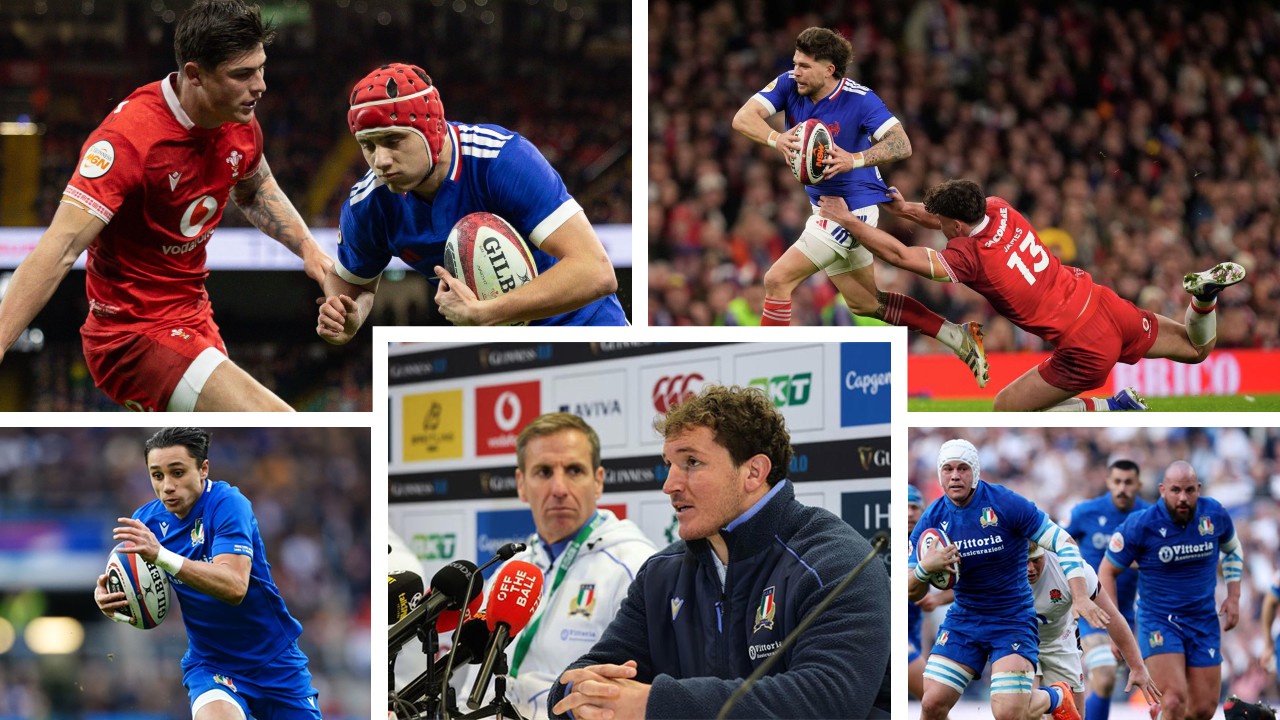
This is another one of those games where you could say, there is very little doubt about the result. However, we’d say stop for a second, that may well be the case, but be honest, isn’t there just a bit more than idle curiosity about how this fabulous Italian side can cope with their next big challenge? If you’re like us, you’d answer yes. Here at the Lineout, we love the underdog, and there is no denying that Italy head into this Sunday’s encounter in Lille firmly labelled with that tag. However, stop for a second and wind the clock back to 2024. Italy arrived in Lille with the same label and shocked the rugby world by almost snatching victory from title favourites France. Had fly-half Paolo Garbisi’s penalty kick at the death found its mark, we would have recorded one of the biggest upsets in Six Nations history.
Wind the clock forward two years, and the same scenario has the potential to be played out once more in exactly the same venue. Add into the mix that this is a vastly more capable Italian team than the one that came visiting in 2024, and all of a sudden, this fixture has more potential spice than a Vindaloo at your local after the pubs have closed. France has, at times, despite its prowess, struggled to wrap its head around Italian sides and how to play them.
In theory, it should be easy to exploit Italy’s impatience, lack of discipline and poor set-piece work. However, here’s the problem: in 2026, Italy does not suffer from those issues. Under Argentinian Coach Gonzalo Quesada, Italy has improved dramatically in all of these areas. Their natural skills have been accentuated, especially in the free-flowing attacking style of rugby they love to play, which is not all that dissimilar to the French modus operandi. However, their set-piece work is now unrecognizable from Italian sides of old, as is their disciplinary record. Their patience and knowing when to play expansively or keep it tight have increased dramatically, and their scrum is now becoming the stuff of legends, along with the rest of their set-piece work. Don’t believe us – watch them giving the Irish front row flying lessons at scrum time last weekend in Dublin. Shock and awe was the only way to describe our collective reaction to the Italian scrum last Saturday.
Michele Lamaro is an outstanding Captain and one of the classiest personalities in the game today. We’ve already mentioned his award-winning moment at the post-match interview after the loss to Ireland last Saturday, in defeat, where he commended both his opponents and took time to make a special mention of the Six Nations’ first-ever female referee, Hollie Davidson, and what a fine job he felt she did and her contribution to the sport, despite him being on the losing side. Lamaro’s now traditional rallying cry at the end of the Italian anthem is enough to inspire anyone – we certainly would happily leap from our bar stools and rush onto the pitch in Italy’s aid if asked to do so by Signor Lamaro.
However, it’s not just Lamaro who fires the imagination. Danilo Fischetti and Simone Ferrari in the front row are already becoming the stuff of legends. Federico Ruzza, in the second row, would consistently make a Lineout first XV, but now has the rather remarkable Alessandro Zambonin ready to emulate the great man. So good is Zambonin that they can afford to put Ruzza on the bench to close out games. That Italian back row is first class with Manuel Zuliani already on every rugby scout’s wishlist alongside his powerhouse partners of Lorenzo Cannone and Michele Lamaro. They have a fantastic 9/10 pairing, which only looks to be even better this weekend with the addition of Bordeaux-based scrum half Martin Page-Relo. Their backline has pace to burn and looks to be augmented this weekend with the return of exceptional fullback and try-scoring gazelle Ange Capuozzo. Unfortunately, the “terror twin” center combo of Juan Ignacio Brex and Tomasso Menoncello will not be reunited this weekend, as Brex remains off duty for personal reasons. Still, Leonardo Marin looked more than handy alongside Menoncello last weekend against Ireland. In short, write Italy off this weekend at your peril, even though the numbers ultimately point to a French side currently sitting as the tournament’s form team sweeping all before them.
As for France, there really isn’t much more to be said. In the absence of scrum half Antoine Dupont’s regular fly half and Toulouse partner Romain Ntamack, Bordeaux superstar 10 Matthieu Jalibert is once again firmly in French Coach Fabien Galthie’s favour. Jalibert has been exceptional this Six Nations, and his partnership with Dupont has been one of the highlights of the Championship so far, especially given that, at the start, many were unsure how well the two superstars would work together. We think it’s safe to say that two rounds in such concerns have been safely filed in the irrelevant drawer of the filing cabinet.
If we have one concern for France this weekend, it’s the scrum, especially after seeing Italy’s in action last weekend. Les Bleus’ front row is solid and backed by a truly exceptional pack, but we’d argue it’s not quite as cohesive as the Italian front three. Defensively, both sides are pretty even, but it’s France’s pace out wide in Louis Bielle-Biarrey and Theo Attisogbe’s powerful running lines on the opposite wing that make France such a challenge to contain. If that’s not enough of a concern, the French centre pairings are equally dangerous, and Menoncello, without his natural partner Brex, may struggle to keep them in check.
Finally, there’s that ever-present, almost unstoppable and hugely skilled French second and back row contingent. Second rower Mikael Guillard already looks to be a contender for player of the tournament, whilst Charles Ollivon’s performance alongside him showed just what a talent he is and has always been, whether in the tight five or as a roving loose forward. France’s back row is rock solid and that is even without the presence of traditional stalwart Gregory Alldritt. We’ve always felt that Anthony Jelonch whether on the flanks or at number eight is one of France’s hardest working and most underrated players, hence our pleasure at really seeing him shine and get the attention he deserves this Six Nations. Francois Cros and exceptional newcomer Oscar Jegou serve to highlight the ridiculous depth France is now blessed with.
What is likely to trip a brave and capable Italian side up, though, in Lille in the final quarter is the battle of the benches. The French bench serves to once more accentuate that depth is now an integral aspect of rugby in France, and whilst the Italian bench is likely to pack some very capable replacements, sadly, at this stage in Italy’s development, they are unlikely to be in the same league as their French opponents – in theory at least.
It may be Lille, and it may be two sides who are even more capable than they were on that remarkable day two years ago. Still, no matter how hard we stir our tea leaves, the feeling is that France is set to continue their seemingly unstoppable march to a Grand Slam in Lille on Sunday. But as two teams who would appear to be doing all the right things in preparing themselves for next year’s World Cup, we have a hunch that you’ll have more than a passing interest in this match and that you are definitely set to be entertained!
France vs Italy – Sunday, February 22nd – 10:10 AM (Eastern) – Premier Sports Canada (and Asia) and Stan Sport Australia (live and on demand)
Well, that’s it for this week, folks, but we think you’ll agree this is quite the weekend to look forward to. So stock the fridge or book your table at your local, make your excuses to family and friends, and let the games begin!
 The Lineout