Excuse the silence of the last few weeks, especially with some rather significant events going on, such as the conclusion of the Women’s Six Nations and that rather tasty Champions Cup Final last week. Time and work management, plus all the pressures associated with the start of warm weather and school finishing, have got in the way of our weekly musings. However, in watching it all unfold and with the start of the hotly debated Nations Championship only a month away, the events of the past few weeks have had us pondering a theme of potential imbalances in the state of the global game at the moment, which forms the underlying thread of this week’s missive and kept our pints rather frothy when we did manage to catch up.
This weekend it’s URC Quarter-Final time and one last round of Super Rugby before the playoffs, while the English Premiership and French TOP 14 also hurtle towards the knockout stages with two rounds left.
So, like we say, some common threads through the group this week as we look ahead to a rather interesting Summer/Fall of International Rugby.
The Rematch Tour, which sees England play three games against Canada, including the headline events in Toronto and Ottawa, seeks to redress the heartache of last year’s World Cup Final loss to the Red Roses – but it’s not exactly a level playing field, is it?

While the headline may sound pessimistic and perhaps negative, it doesn’t take away from the genuine excitement here at the Lineout about the privilege of getting to watch here in Canada, in our home, Toronto, as our fabulous Women take on the World Champions, England. We hope that, like us, you are telling all your friends, colleagues and even the person you sit next to on your daily commute to work all about the two dates in October at Toronto’s BMO Field and then TD Place in Ottawa. We want to see a capacity crowd for both games. These remarkable Women deserve the support and have certainly earned the respect of a proud nation. So, make sure you’re there!
However, as excited as we are, we don’t particularly like the way it is being marketed. A Rematch Tour – really? The circumstances now are so different that it’s a Test series, plain and simple. The World Cup is now ancient history, and both sides now find themselves on different paths in their development. It’s perhaps this area that concerns us slightly ahead of these three fixtures. England’s preparations for this Series will have been infinitely better than Canada’s by the first kickoff in Exeter at the end of September. Canada will play England three times, first up in England at Exeter’s Sandy Park, then two matches in Canada in Toronto and Ottawa.
By the time the two sides meet in Exeter, England could well be coming off the back of an unprecedented 39-game winning streak, assuming they beat Australia on September 12th. They are back-to-back Six Nations Champions since 2018, including 5 consecutive Grand Slams, are World Champions, and are ranked the number one side in the World by quite the Country Mile. Furthermore, before arriving in Canada, and after playing the game in Exeter, England will have a further warm-up against New Zealand’s Black Ferns, who won the Pacific Four Champions title this year by beating Canada and, in the process, relinquished Canada of their number two spot in the World Rankings. In short, England will have played 8 high-intensity Test matches before arriving in Toronto.
Canada, by comparison, is no longer the second-best side in the World; that honour has now passed to New Zealand’s Black Ferns. If England win their games against Australia, Canada and New Zealand before they arrive in Toronto, that will take the Red Roses to an unheard-of 41-Test-match winning streak, making them arguably one of the most consistently successful International sporting teams to ever walk the planet. In contrast, by the time the opening whistle gets blown at Toronto’s BMO Field on October 16th, Canada will have played a mere 4 Test matches, with only their game against New Zealand in this year’s Pacific Four Series, which sadly they lost, providing them the calibre of opposition needed to prepare for facing the Red Rose juggernaut. Of those four Test matches, one will be the “Rematch Tour’s” opener against England in Exeter. Consequently, in reality, before facing the best team in the World, Canada will have had a mere three Tests – not exactly ideal preparation.
None of this is to say that, on home soil and, hopefully, in front of capacity stadiums full of loyal and passionate Canadian fans, our remarkable Canadian Women can’t put the brakes on England’s wrecking ball. This is a highly talented and exceptionally skilled team whose commitment and work ethic are beyond question, but the team that clawed its way to a World Cup Final last year against all the odds is not exactly what the 2026 edition looks like. While they were strong runners-up for this year’s Pacific Four Series, there was no denying there was definite rustiness around Canada’s game. The second-half performance against an utterly ruthless Black Ferns side left a lot to be desired, with Canada essentially outplayed in the type of game with which they blew New Zealand off the park in the World Cup Semi-Final. Decision-making and execution were uncharacteristically poor in the second half, and even in the first half, which Canada won, Canada’s performance looked clunky at times, and more like New Zealand simply finding their feet in preparation for a second-half masterclass.
Perhaps what concerned us most was that Canada looked genuinely rattled in that second half against New Zealand, a trait that never really came to light throughout the World Cup, even in the Final, where their backs were against the wall, and they faced seemingly overwhelming odds. Canada looked like the side that turned everyone’s heads at last year’s World Cup in their final Pacific Four game against the USA, and we hope that the confidence gained in that match will carry them through in this tough three-match assignment with England. Furthermore, many of the squad likely to face England will have been playing their club rugby in the world’s best Club competition this season, England’s Premiership Women’s Rugby (PWR), and as a result will have an intimate knowledge of many of their opponents. In addition, outstanding Canadian Coach Kevin Rouet has been on sabbatical with Saracens in the PWR as their attack coach, so he will have in-depth knowledge of English Coaching systems and a chance to study in detail the players his charges will be up against this Fall.
It’s just the lack of game time that concerns us ahead of three games that could be a huge opportunity to further the development and already exceptional ability of Canada’s Women. This three-Test series has absolutely no relation whatsoever to last year’s World Cup, and we simply won’t refer to it as a Rematch Tour (that’s a rather tacky marketing gimmick, as far as we’re concerned). Instead, it’s a rebuilding process to get Canada back on the road to being genuine contenders once more for the next Women’s World Cup in Australia in 2029. Furthermore, the opportunity to really put Women’s Rugby on the map here at home is enormous with this Series. As a result, three good performances, especially the two in Toronto and Ottawa, could do wonders to really engage a growing fanbase for the sport in this country. In short, it’s high-stakes stuff – and Canada will be up for it; make no mistake. Still, given that they will have considerably less preparation than their opponents, it is our hope that steps will be put in place between now and that first Test in Exeter on September 19th to give them the best possible fighting chance that they have both earned and deserve.
The new highly controversial Nations Championship tournament kicks off next month, and we simply don’t know what to make of it – does anyone, including the teams themselves?

Well, it’s happening, whether we like it or not. The new lumpy arrangement concocted by World Rugby, SANZAAR and the Six Nations kicks off in July, supposedly taking the rivalry between the Northern and Southern Hemispheres to a new level. Somehow, this is all meant to have meaning when juxtaposed with the World Cup, held every four years, while this tournament takes place every two years. It replaces traditional summer and autumn Tours, which saw the North travelling South during July and the South travelling North in November.
While November’s structure, in essence, hasn’t really changed from regular Fall Tours of the Northern Hemisphere by the big teams from the South, the July format is downright awkward, with some teams racking up a spectacular number of air miles in just three weeks. Add in the confusing aspect that Japan, to be included, has metamorphosed into a Southern Hemisphere nation. Still, during the three-match July period, it has to play one of its home games in Australia. Meanwhile, a bona fide Southern Hemisphere Nation, Fiji, gets no home games whatsoever and gets transplanted to the temporary Fijian overseas territories of Cardiff, Liverpool and Edinburgh for their home games. To rub salt into the wound, throughout the entire competition, Fiji doesn’t play a single game at home in either July or November.
Let’s throw another spanner in the works by making the point that the best of the North and the South are unlikely to meet in the Finals. Why, you ask? Well, let’s look at it this way. To get to the Finals at the end of November, you need a strong showing in July. France, as reigning back-to-back Six Nations Champions, are unlikely to do well on their Tour to play Australia, Japan and New Zealand in July. Coming off the back of the most exhausting Club competition there is, the TOP14, many of the best French players are unlikely to participate due to sheer fatigue. Given France’s now extraordinary depth, they are still likely to field a rather capable side, but it won’t be their Six Nations-winning side. Consequently, a loss to New Zealand and possibly Australia is not beyond the realms of possibility. That would then mean them having to beat Fiji, South Africa and Argentina in November to reach the final, which sees the top Northern Hemisphere side pitted against the top Southern Hemisphere side and be the top dog. Beating South Africa these days is a serious challenge.
In addition to France’s issues over the summer and the Fijians being granted temporary British citizenship, there is also the exhausting travel schedule for many teams in July. England, Scotland and Wales have a particularly gruelling 3-week schedule, seeing them in Johannesburg, Córdoba and Cardiff, respectively, on the first weekend. On the second weekend, England packs their bags and rushes back to Liverpool to play their favourite British cousins, the Fijians. At the same time, Scotland crosses the Southern Atlantic for a date with South Africa in Pretoria at altitude, and Wales scuttles off to San Juan in Argentina. Finally, a week later for the final round, England jet off to the North of Argentina, Scotland dash back to Murrayfield for a date with the Fijians, and Wales drag themselves across the Atlantic for a seaside holiday in Durban. If any of these three teams manage to figure out what time zone they’re in and whether they should be eating breakfast, dinner, or lunch, all while trying to avoid deep vein thrombosis, it will be impressive, let alone play three high-intensity Test matches.
In short, the November window works, as Fiji, Japan, Australia, South Africa, Argentina and New Zealand all head to Europe like they always do. Once they get there, the travel distances are relatively short. However, this summer schedule and its ramifications make the Finals weekend a bit comical and a tad meaningless, if you ask us, let alone providing a level playing field. Don’t get us started on carbon footprints and player welfare, as apparently these are irrelevant concerns.
Anyway, enough of the negativity. It is a very long way from perfect, but warts and all, there is still some interest in it, especially a year out from a World Cup. It will give us, to some degree, an idea of where the teams stand and what the pecking order for next year’s showdown in Australia may look like. If we end up having to eat humble pie, the Northern Hemisphere sides come away from their Southern Hemisphere air-miles extravaganzas with a healthy set of wins in the bag. All of a sudden, those four weekends in November will take on a whole different meaning and relevance, especially with an eye to the World Cup. If it is a relative success, then perhaps future editions will have a more player-friendly schedule, and perhaps a long-awaited genuine attempt at a realistic and sensible global calendar will start to emerge.
In short, it is what it is, and we’d be lying if we said that, despite our reservations, we won’t be casting a decidedly interested eye over proceedings in July and November. We also haven’t talked about the Rugby Nations Cup, a sister tournament that runs in a similar format for Tier 2 Nations during the same window and which Canada will be playing in – more on that later. Enjoy it for what it’s worth, and Test Rugby in whatever shape or form is always worthwhile!
Mirror, Mirror on the Wall, which is the fairest competition of them all?

This subject produces some pretty violent debates, all of which show no signs of abating. Quite frankly, from a purely objective standpoint, we’d argue that France’s TOP14 is the most dramatic and colourful competition, with the type of fan engagement and funding the other three leagues would die for. Super Rugby certainly produces some incredible rugby, but since South African sides left the competition, it has lacked the international rivalry that made it so intense and challenging. It has an international flavour in the shape of the Australia and Fiji sides, but these teams rarely make it beyond the first round of the playoffs in recent years. Consequently, there is always an air of inevitability about the Finals essentially being all-New Zealand affairs. The United Rugby Championship has grown in popularity with the introduction of South African sides. It has a genuine international flavour, but the logistics of the whole thing have often detracted from the product’s quality. Meanwhile, we’d argue that the English Premiership, as a high-quality competition, has improved every year, especially over the last two years. However, the culling of some much-loved clubs in the process and padding out of others has left a sour taste in many a mouth – hands up if you still miss Wasps and London Irish but really have little interest in Formula 1 wannabees, the Newcastle Red Bulls.
In our humble opinion, we rate France’s TOP14 competition as the premier Club league on the planet. Bordeaux-Begles’ second consecutive Champions Cup title last weekend, and the fact that French sides have won the title consistently since 2021 and more than any other country since its inception when rugby went professional in 1995, make for a pretty convincing argument that the domestic and club game in France is in rather rude health and appears to be getting stronger. In addition to the Champions Cup, French and English sides have also won the second Tier of European Club competition, the Challenge Cup, more than any other at 13 apiece. In fairness to Super Rugby, it doesn’t have a benchmark like the Champions Cup to measure itself against, but let’s be honest, a clash between Bordeaux and the Hurricanes would be a mouthwatering prospect. We’ve argued for a long time that a once-off game every year between the Super Rugby Champions and the Champions Cup winner would be something we would love to watch. It is coming in the form of a World Cup every four years, starting in 2028, for Rugby clubs, but we feel that is overkill in an already crowded global calendar.
However, back to France and its glorious clubs. As the best-funded league on the planet, it is little wonder that French club rugby is as good as it is. However, it’s also about building the product and letting people come. France, particularly in the South, always had a strong rugby following and passionate tribal rivalries. However, in the professional era, it has hit top gear and shows no signs of abating. Although the top French clubs have extremely deep pockets, the development of depth in France’s own player base has been extraordinary. Although some clubs, such as Toulouse and Toulon, were famous for bringing in big superstars from overseas, the trend over the last few years has been to increasingly rely on local player academies. It’s interesting to note that of Bordeaux’s Champions Cup Final matchday 23 last Saturday, only 5 players were not French. Watch a TOP14 match, and you’ll be hard-pressed to find an empty seat; compare that to the often barren stands at some Super Rugby and URC games. The packed stands at Bilbao last Saturday for the Champions Cup Final, with a huge, colourful, and very loud Bordeaux contingent, made the whole event even more of a spectacle than it already was. You’ll see the same thing at the TOP14 Final at the Stade de France, with the stands singing, dancing and generally having an absolute blast akin to the kind of fan participation you see at football matches. It’s that kind of fan engagement which brings in the money, plain and simple, and with it success.
In terms of full-throttle, all-out rugby, we’d argue that Super Rugby comes close second to the TOP14. It may not quite have the fan engagement of its French counterpart, but certainly in New Zealand and especially Fiji, watch any home game of the Drua if you don’t believe us; the fans are there and passionate about their rugby. In Australia, sadly, the same cannot be said, and it’s probably not helped by the fact that an Australian side hasn’t won the competition since 2014. From an Australian perspective, there is a growing sense of inevitability about the tournament, which is affecting interest and, as a result, Australian rugby as a whole suffers. Australian sides will play some solid, and at times highly exciting, games, but ultimately run out of puff and depth come the knockout stages, leaving New Zealand sides to reign supreme. It’s as if there is a sense that Australian sides are being invited to play in a New Zealand domestic competition just for the regular season to add a bit of spice to proceedings.
With one round to go before the knockouts, the two top spots in this year’s Super Rugby are dominated by New Zealand sides, with plenty of daylight between them and the third and fourth-placed New Zealand compatriots, the Blues and Crusaders. The Brumbies and Reds are clinging to fifth and sixth, but their form this year has been so hit-and-miss that it’s highly unlikely they will get past the first round of the knockout stages. In short, a great competition that produces some thrilling rugby, but with inconsistent fan engagement and an air of inevitability around the fortunes of sides outside New Zealand’s top 4, it lacks the level of interest needed for a full season.
Without sounding Northern Hemisphere-biased, the English Premiership and the URC have kept us more engaged than Super Rugby. With its International component, the URC is pretty hard to beat and certainly seems to be growing in both quality and popularity. That being said, in the case of the URC, the playing field is certainly far from level. Irish sides, until the arrival of South African teams in 2021, tended to dominate, while Welsh, Italian and Scottish sides produced some brave and thrilling efforts during the course of the season, but could rarely go the distance. Despite the logistics, South African sides have made a serious impact on the tournament, winning it in their first year of participation courtesy of the Stormers, and the Final has featured a South African side every year since then.
However, with the advent of the URC, Scottish side Glasgow has also shown the potential this proud club always had and, in 2024, claimed the title by beating the Bulls at altitude in South Africa. This year, a similar pattern has emerged, with the Bulls and Stormers looking like the sides to beat from South Africa, and Leinster and Glasgow the sides to beat North of the Equator. Other teams have and continue to challenge, but the reality is that the competition is, for all intents and purposes, all about these four clubs, at least for the foreseeable future. Ireland’s Munster has a proud pedigree, and Ulster has some serious grit and significant, if somewhat inconsistent, promise. Cardiff have shown remarkable resilience and excellence at times despite the appalling management of the game in Wales, and Italy’s Benetton and South Africa’s Sharks are always a threat in the making. These last two sides should be doing so much better than their results show. In short, it’s a great competition with some quality sides. Still, the last couple of years have seen a fairly predictable pattern emerge as the knockouts approach, and this weekend’s quarter-finals, barring some wild card upsets, look set to continue the trend.
Finally, there’s the English Premiership, and in fairness, we think it has the potential, perhaps more than any of the other leagues, to genuinely give France’s TOP14 a run for its money. While we don’t tend to cover it in our musings, we will be the first to admit that we always look forward to and watch the Premiership Final at Twickenham. It’s always a great game and just one of those pinnacle events in Club Rugby’s annual calendar. The rivalries and histories between Clubs span decades and are as intense as anything you’ll see in France; perhaps only the Munster/Leinster rivalry in the URC can match them. This year, as we approach the knockout stages, it’s a three-horse race between Northampton, Bath and Leicester, and at this stage it’s impossible to call, with Exeter Chiefs, Saracens and Bristol Bears all capable of spoiling the party for these three frontrunners. What we perhaps don’t like as much about the Premiership is its tendency, particularly amongst its investors, to promote superstars over clubs, which clashes somewhat with rugby’s club grassroots ethos and is more akin to some of the negative aspects of Premier League football. While we thoroughly enjoy watching the skill levels of Henry Pollock and Marcus Smith, the fact that they’ve been snapped up by high-profile management agencies who want to see them at the front and centre of everything happening on the pitch detracts somewhat from the game. It risks becoming some sort of NFL sideshow.
In conclusion, we’d argue that the TOP14 model is the one closest to getting it right in terms of how to run and develop a successful competition. If we have one criticism, it would be to make the season just a few weeks shorter, both for player welfare and to allow the raft of hugely talented French players a better shot at International Test glory and duty. Super Rugby always entertains and produces some truly extraordinary rugby. Still, the playing field is simply not level, making it, for all intents and purposes, a glorified New Zealand domestic league despite its international component. The URC is a great competition that, in theory, has it all. However, disparities in logistics and funding among participants mean that only a handful of teams are genuinely in it to win it every year. Finally, the English Premiership is a terrific competition that appears to be getting back to its former glories at a rate of knots, with the Final every year being something everyone’s rugby viewing calendar should include.
The first of this year’s Club competitions arrives at it’s knockout stage, but it does all seem a little bit predictable this year for the most part in the URC.
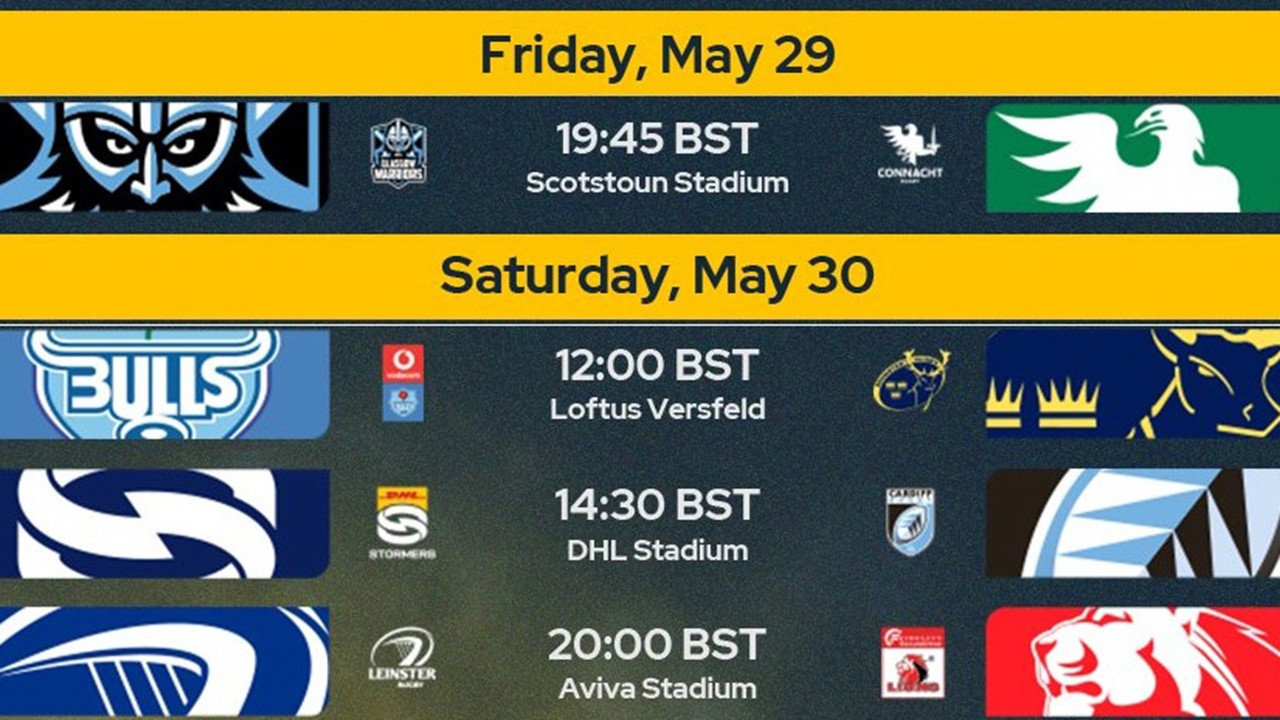
It’s Quarter-Final time in the URC, but there doesn’t seem to be a huge sense of jeopardy in it all. For the four visiting teams, Cardiff, the Lions, Connacht, and Munster, their respective tasks are daunting to say the least, even putting aside the fact that three of the visiting teams have journeys of 8,000 miles to add to the challenge, with Munster having to play at altitude as well.
Friday’s dustup in Glasgow between the Warriors and Connacht is perhaps the game with the most jeopardy, but even that may be pushing it. Connacht come into this game on a rather impressive run of form, including an impressive away win over the Stormers, which they were unable to repeat a week later against the Lions in Johannesburg. However, there is clear evidence that under the tutelage of Coach Stuart Lancaster, Connacht are starting to get to where they’ve always promised they should be. However, Glasgow’s all-star lineup will be a challenge for most teams to handle, especially on home ground. The Warriors are predicted as heavy favourites to win, but this could be the closest-fought encounter of all this weekend’s Quarter-Finals.
Saturday’s spread of action starts in Pretoria as the Bulls host an injury stricken Munster, with the biggest potential omission being fly half Jack Crowley. Munster have simply not been at their best this season and their form away from home for the most part has been particularly concerning despite some strong performances at home. The Bulls have had a solid season and were unlucky to not go deeper into the Champions Cup knockout stages than they did. However, it’s interesting to note that the last time the Bulls and Munster clashed this season it was also in Pretoria and the Bulls had to dig deep into their box of tricks to walk away with the narrow 34-31 win. So if the injury gods are kind to Munster then maybe this might be much less of a one sided affair than many are predicting it to be.
The third Quarter-Final sees the Stormers take on the surprise package of the season, Cardiff Blues, in Cape Town. Despite the carnage going on in the management of the game in Wales, the Blues have somehow managed to rise above it and have been a particularly awkward side for their opponents all season. They play a solid, well-rounded game and may just be a match for a Stormers outfit that has occasionally misfired at critical junctures in this season’s competition. The Stormers are not without some nagging injury/form concerns, especially around the Springbok duo of Damian Willemse at fullback and fly-half sensation of the last 12 months, Sacha Feinberg-Mngomezulu. In the case of Feinberg-Mngomezulu, there is no doubting his extraordinary talent, but some alarming dips in form and consistency have raised questions. Meanwhile, Cardiff are simply a well-rounded team. However, they don’t have the Springbok superstars the Stormers possess, but their sense of team cohesion will put them in excellent standing against a tough opponent on Saturday. Furthermore, let’s not forget that only two weeks ago, the last time these two met in Cardiff, the Welshmen emerged the victors.
Finally, we wrap the weekend up with Leinster taking on the Lions. On paper, this should be a done deal in favour of the Men in Blue who call Dublin home. However, the Lions have been a real surprise package this season, producing some spectacular performances. Admittedly, they appear to be a team that doesn’t travel all that well, and their two games leading up to this fixture against both Leinster and Munster didn’t exactly fill one with confidence.
However, if you take a stats dive, all of a sudden, this contest doesn’t appear quite as one-sided as it looks. The Lions have made more line breaks than Leinster this season and beaten considerably more defenders. Given that, for reasons best known to himself, Leinster Coach Leo Cullen has opted for defensive liability par excellence, Sam Prendergast, as his starting fly half, the Lions must be licking their lips. However, in defence, the Lions have missed more tackles than Leinster, but both teams have a less-than-stellar 78% tackle success rate. The Lions have also won more turnovers than Leinster and have also lost considerably fewer turnovers than the Irishmen. Discipline-wise, the Lions have a considerably cleaner sheet than Leinster. Still, when it comes to lineout time, sadly, the South Africans are a bit of a shambles compared to what is one of the strongest aspects of Leinster’s set-piece play, with both sides having issues at scrum time.
In short, all these Quarter-Finals lean heavily in favour of the four home sides, and at first glance, the results would appear to be a foregone conclusion. However, we have a hunch that there could possibly be a few surprises in store. Leinster are smarting from their Champions Cup humiliation by Bordeaux and have a habit of fluffing their lines on big occasions. The Stormers’ quality is solid, but consistency in form is not one of their strengths, and the same could be said of Glasgow. Munster have a habit of turning up when you least expect them, and the Bulls are prone to sticking to a game plan regardless of whether it’s working.or not So yes, while the bookies’ predictions are probably right, we’d argue there is plenty on offer this weekend to catch your interest, and who doesn’t love the thought of a potential upset for the record books here and there?
Glasgow vs Connacht – Friday, May 29th – 2:45 PM (Eastern) – Sportsnet+ and FLO Rugby (live and on demand)
Bulls vs Munster – Saturday, May 30th – 7:00 AM (Eastern) – Sportsnet+ and FLO Rugby (live and on demand)
Stormers vs Cardiff – Saturday, May 30th – 9:30 AM (Eastern) – Sportsnet+ and FLO Rugby (live and on demand)
Leinster vs Lions – Saturday, May 30th – 3:00 PM (Eastern) – Sportsnet+ and FLO Rugby (live and on demand)
Well, that’s it for this week, folks. Enjoy the action this weekend and start looking forward to Test Rugby, which is just around the corner, as is summer, or at least that’s what they tell us!

