That Friday, back at the beginning of September, when we all crowded around our TV screens to watch France and New Zealand, kick off Rugby World Cup 2023, now suddenly seems a very long time ago. Since then, a World Cup that was never going to be without its controversies has still somehow managed to deliver one of the most enthralling tournaments since its inception back in 1987.
Many of us, myself and my family included, were lucky enough to be there in person for some of it. The lopsided nature of the draw had its downsides, but nevertheless, in the Quarter Finals in Paris, we were treated to two of the greatest games of rugby we are likely to ever see. There was heartbreak for the host nation France far too early, and despite some of the local interest being somewhat diminished after Les Bleus Quarter Final exit, the Final itself was one for the ages which ultimately saw a team who had perhaps fought for it harder than any other, emerge worthy winners. The Pool stages showcased that despite World Rugby’s best efforts to ensure that the Top Tiers of Rugby remain an exclusive and elite club, rugby is alive and well in many far flung corners of the globe and building a passionate and committed fan base.
In short, it’s been a glorious two months that has brought with it the full range of emotions that such a showpiece event should have. We’ve all cheered, laughed, cried, made new friends, and been wrapped up in a genuine celebration of all the good things about our glorious sport. Despite some distractions, Rugby, for the most part, remains a noble game with its bedrock values of sportsmanship, camaraderie, and respect still very much intact.
In this piece, we’ll look at the things that struck us most about this World Cup and what it means for the future. We’ll be doing a separate piece on what we think the five teams that have emerged atop the World Rankings have learnt from this World Cup, and what they need to do with an eye to the next global showdown in Australia in 2027. However, for now, it’s savoring the fine glass of wine that Rugby World Cup 2023 France has been, which is most important.
So, without any further ado, here’s what struck me most about the last eight weeks, including a memorable two week sojourn in France.
It wasn’t perfect, but France is still a glorious place to host a World Cup

France is just a great place to host a Rugby World Cup – that’s all there is to it. Sure, there were some teething problems in the opening weeks of the tournament, but even without France featuring in the final two weekends, the country embraced the tournament hook, line, and sinker. Everywhere you went, you were reminded that France was hosting Rugby’s big show. Although France were knocked out early, and as a result the interest was perhaps not as all encompassing as it could have been, there was still plenty of bonhomie and good cheer towards the supporters of the remaining participating nations who were to be seen everywhere. Some cities such as Toulouse, where we ended our own trip, simply live and breathe rugby – it’s everywhere. Kids were playing rugby in the old town squares, rugby balls were to be seen in every shop window and before long you’d find yourself at the Stade Toulousain shop kitting yourself out in one of their famous jerseys.
People were friendly, enthusiastic, and perhaps best of all even in Paris, you never felt that you were being taken advantage of. Let’s face it there was plenty of opportunity to gouge fans of their hard earned trip of a lifetime cash, but it just never felt like that. Fans at the packed Stade de France for the two Quarter Finals we were at were, for the most part, orderly and respectful. The trains ran well and on time. It was easy to get to and from the games despite the 80,000 plus in attendance at both. The atmosphere was incredible at the Stade de France, and we wouldn’t have missed it for the world.
Our whole experience was perhaps best summed up on our final day in Toulouse, as I took my 11 year old son to the Stade Toulousain shop in the centre of town before catching the train back to Paris and our flight home. Still proudly wearing his French shirt, one of the shop assistants smiled at him as he bought his Toulouse jersey, as his two favorite players, Romain Ntamack and Antoine Dupont, play for the famous French club. “Don’t worry, son,” he said, “we may not have won, but you were here and shared our journey with us – and that is what is important.”
Thank you France!
South Africa’s win showed that sometimes the desire to win can be even more important than the skills needed to do so

South Africa is the most successful country in World Cup history, having now won the Webb Ellis trophy four times. While they may not have played the most attractive rugby at times, they showed that they simply know better than anyone how to win those fine margins at this level, and what it means to them and their country. Every country deserves to lift a World Cup, but as the tournament progressed, it was very hard not to get behind South Africa regardless of who you supported. South Africans don’t have much to cheer about a lot of the time given the problems their country is grappling with, but it was plain to see how much winning this World Cup meant to them, and especially to do it against their greatest rivals of all time New Zealand.
Their Captain, Siya Kolisi, has been one of the standout players of the tournament. He has embodied the principle of leading from the front and what it means to play for your country. His humility and pride in the jersey has been humbling to watch, as has his remarkable ability to make everyone on the team feel included in South Africa’s remarkable journey this past two months. While this may be his last World Cup in the green and gold, his legacy will serve as an inspiration to not only those in his own country but people around the world for generations to come. In our humble opinion, he is one of the greatest sportsmen of all time, and many could do well to emulate his example, particularly in terms of how to be a leader.
South Africa had perhaps the toughest route to the final of any of the teams. Starting off in the Pool of Death, which saw them lose to Ireland, they had to face the hosts France in the Quarters. That Quarter Final was without doubt one of the most remarkable games of rugby we have ever witnessed, but as they did in all their knockout games, South Africa found a way to control those final ten minutes and secure a one point win, even if all the odds screamed against it. They did the same against England a week later, and then we all know what happened last Saturday against New Zealand. Knockout rugby is a game of very, very fine margins and it’s safe to say that South Africa perhaps more than any other Test nation, know how deep you have to dig to eke out those wins. In between World Cups, that quality may not be very evident in the Springboks, but come the World Cup, they often become a completely different animal.
The World Cup is special for everyone and the pinnacle of any rugby player’s career, but the legacy left by Francois Pienaar and his charges that memorable day back in 1995 in Johannesburg is burned deep into the Springbok psyche, as it continues to unite a nation. Put aside all your technical analysis and stats, and we think you’ll find that it’s that spirit which ends up being the X-factor that brings South Africa home and gives them an edge come World Cups that few other countries can really muster.
Thank you, South Africa, for a remarkable World Cup campaign and sharing your journey in how to unite a nation with us!
Spare a thought for New Zealand and in particular Sam Cane

Saturday’s World Cup Final in Paris was a clash between two of International Rugby’s greatest and fiercest rivals. A contest between these two countries is always an awe-inspiring occasion and one of International Sport’s greatest spectacles. Consequently, no quarter is ever given by either side, and Saturday’s encounter saw 46 men throw everything they had into a titanic contest. It may not have been a high scoring affair, but bodies were put on the line and sacrifices made for the full eighty minutes in a pulsating contest that hinged on the finest of margins.
New Zealand are a proud rugby nation, with perhaps the longest and greatest tradition in the sport. Pulling on that black jersey carries exactly the same weight and pride as the Springbok jersey does. Victory elates a nation while defeat breaks 5 million hearts in an instant. The players know the expectation that lies behind the jersey, and failure is a heavy burden to bear.
Spare a thought therefore for New Zealand’s Captain Sam Cane, whose red card reduced his side to 14 men. Put aside the debate around the legitimacy of said card, even though practically everyone agrees that within the letter of the laws as they stand, it was the correct call. Sam Cane has overcome enormous obstacles in his career to get to where he is and potentially lead his side to World Cup glory. He is a decent man and a fine player, and never once have we seen him play in a manner that could jeopardize that character assessment. As a result, having to watch him sidelined on the bench as his country were a man down for much of the match was heartbreaking. It was clear that he felt he had let his team down when they needed him most, and watching him bear such a burden of guilt was hard to take.
To give credit to New Zealand, in his absence, they notched it up another couple of gears and to a man played for their sidelined Captain. They appeared to have the measure of South Africa in the third quarter, and you felt that the engravers would soon be starting to carve the letter N and beyond on the base of the Webb Ellis trophy. However, despite a truly extraordinary effort from New Zealand, it wasn’t to be as the Springboks much vaunted ability to find that extra bit of grunt and resolve to win big games like this once more came to the fore. New Zealand DID not lose that game because of Sam Cane. If anything, in the second half, they became stronger as a result of his predicament. New Zealand were exceptionally worthy finalists who played an outstanding game but lost on the smallest of margins. In short, there is everything to be proud of despite the loss.
Well done, New Zealand. You played some fantastic rugby this World Cup, and you’ll be back stronger as a result!
The abuse piled on referees at times this tournament has NO place in our game – plain and simple!
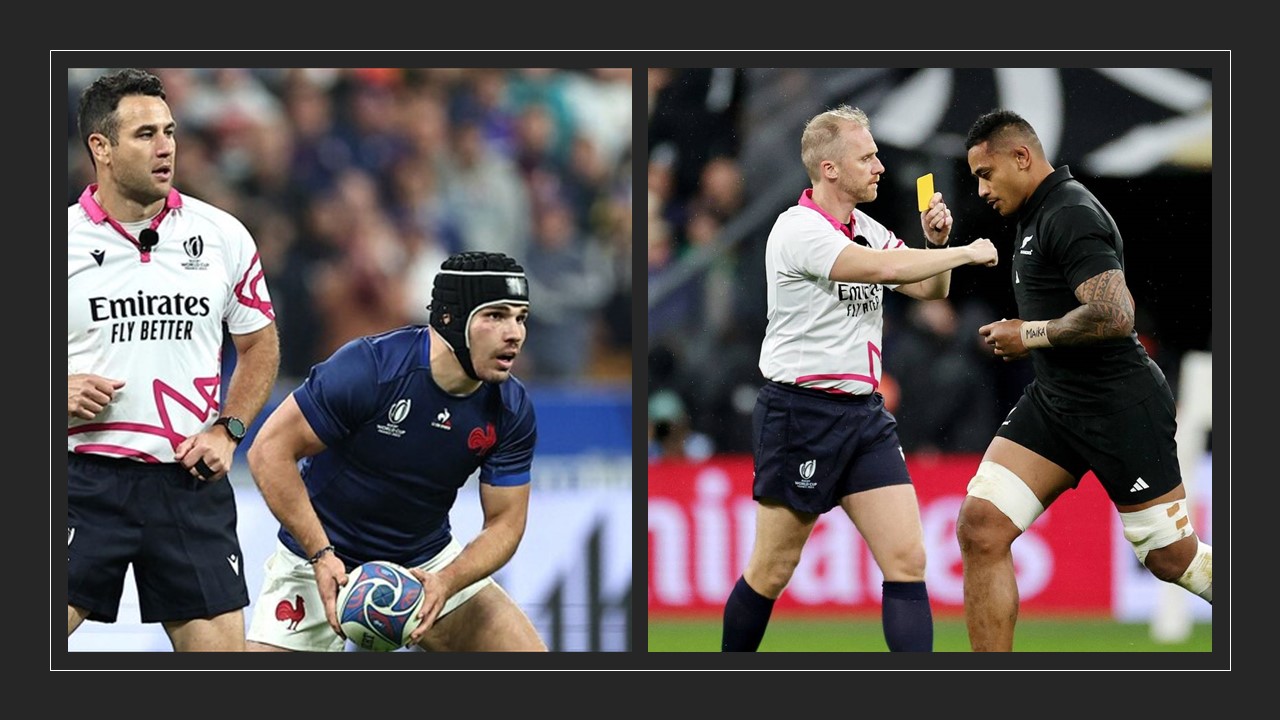
Let’s face it, being a Test Rugby referee is probably one of the hardest and most thankless tasks on the planet. Sure there were some big calls this tournament, but for the most part in the crunch matches from the knockout stages onwards we felt that, even allowing for the odd inevitable mistake or borderline decision, the standard of officiating in this tournament has been exceptionally high. As a result, imagine our disappointment at reading of death threats being made against Ben O’Keefe after the France/South Africa final and then Wayne Barnes after the Final between New Zealand and South Africa. Furthermore, numerous officials have been subjected to abuse and put in the crosshairs of social media after certain matches. In short, it is simply unacceptable and must be condemned from the top down and by us as rugby fans.
In the specific cases of both Ben O’Keefe and Wayne Barnes, these are two fine and fair individuals who consistently deliver at the highest level. Are they human? Absolutely, and as a result, they and their team will occasionally miss aspects of the game, which may or may not have had an influence on the ultimate outcome of the match.
As we have repeatedly said, and as echoed by one of the game’s greatest, former Welsh referee Nigel Owens, rugby is an exceptionally fluid, complex, highly technical and dynamic game which requires officials to have not just one but several pairs of eyes in the back of their heads. We share Owens’ concerns that the game has become slightly too technical from a law point of view, and the influence of TMOs could at times be reduced. Some of the technicalities involved not only confuse players and spectators alike, but disrupt the flow of the game and require the officials to have both PhDs in rugby law as well as be able to have a sense of spatial perception that even the most gifted players are incapable of.
Nevertheless, if you look at the two big games that Ben O’Keefe and Wayne Barnes were involved with – the France/South Africa Quarter Final and the New Zealand/South Africa Final, there is unanimous consent that within the letter of the law as it stands now they got the calls right, as hard as it may be for both the losing sides to swallow given there was only one point in both games separating the teams at the final whistle. France lost to South Africa, not because of the officiating but because of some exceptionally poor decision making in the final ten minutes, and New Zealand lost in the Final not because of the red card but because of some uncharacteristically poor goal kicking on their part. Had those kicks gone through New Zealand would have beaten South Africa just as they beat Ireland two weeks earlier by 4 points, even with 14 men.
At the end of the day, teams know that some decisions will go against them, and others will give them a golden, albeit lucky opportunity. It’s how you manage those opportunities and with it the expectations of the officials on any given day that wins you matches. On their own respective days, both France and New Zealand fell just short. We agree that the lawmakers need to take a long hard look at how officiating is carried out, as well as simplify the rule book somewhat after this World Cup, but the derision and threats that O’Keefe and Barnes have received have no place in our sport.
To Barnes and O’Keefe we offer our thanks and respect along with all the other officials and referees who were given an almost impossible task this past two months, but who performed admirably day in day out and in the face of endless criticism and hostility. In short, job well done!
Out with the old as we look ahead to a not so brave new world!

So it’s off to Australia in four years’ time, with a bigger tournament and more teams. Eddie Jones failed to deliver Australia’s new dawn in the most spectacular fashion, and Bill Beaumont and World Rugby firmly slammed the door in the face of countries like Portugal, Samoa, Georgia and Uruguay who so inspired us this tournament, at least until 2030. There has been so much to be positive about in this World Cup, but International Rugby is definitely not at the gates of a Brave New World after this World Cup. The upper levels of Rugby’s management remain littered with out of touch dinosaurs in bloated blazers who have little or no interest in how to tap into the potential of rugby in the 21st century. Beaumont’s cozy relationship with the disgraced former President of the French Rugby Federation Bernard Laporte, who is now on trial for fraud, corruption and embezzlement, showed that World Rugby in its present state is nothing more than a cozy cabal of self serving individuals enjoying a rather comfortable ride to their retirement nests.
Bill Beaumont’s term as World Rugby Chairman is up at the end of 2024, and he simply has to go if a legacy for the future can be created in Australia in four years’ time. His main challenger four years ago, Agustin Pichot from Argentina is the only person we’ve seen in World Rugby who has a genuinely exciting and inclusive plan for the future of the sport globally, but his radical thinking was an anathema to the comfortable club that sits at the top of the World Rugby order. Eddie Jones’ departure from the Wallabies was inevitable after this World Cup, but as always, with Jones, it was done in a manner that made it all about him and exemplified his divisive nature. However, much like Beaumont and company, he is a relic of the past and hopefully will start to quickly fade into rugby history. Has his departure from the Wallabies been timed for a run at Beaumont’s replacement? We sincerely hope not.
Thank you to all 20 teams, players and Coaches in this year’s Rugby World Cup, who showed us that despite the staggering level of incompetence and self interest shown by Rugby’s governing bodies both Nationally and Internationally, the love and joy of playing our glorious game is what keeps people coming back for more, and packing the stands to the rafters! They have shown us that Rugby as a global sport is at a crossroads that can only benefit the many rather than the few if the right decisions are made. To the players, coaches, and fans of this Rugby World Cup – we salute you and share your hopes and dreams for the future!!!!
 The Lineout
Hi Neil, thanks for this great review and summing up. I think you’ve covered all the important aspects very well. Really glad that you and your family had a great time and caught two fantastic matches.
My personal gripe is still with the lack of ticket availability for us ordinary Joes or Pierres, there were many matches with empty seats, and unfortunately this was specifically, or spectacularly, omitted from coverage. They did put SF tickets on resale but only two days before the matches (around €350-€500 depending on seat location – I don’t think that’s too bad a price point when compared with the soccer WC), but the logistics of then being able to book reasonably priced train tickets and find overnight accommodation in Paris at such short notice, put this out of our price bracket unfortunately.
Well, here’s twiddling thumbs until February and the Six Nations’ matches!
LikeLike
As always thanks Micky. Yes did find some aspects of the ticketing a headache, for example both official ticketing windows last year were impossible for us to get onto, and in the end had to go through a sports travel agent, which although worked like a charm was not exactly a cheap way to do it. And yes can only imagine what train and hotels must have been like at short notice so feel for you on that one.
Like you say now it’s that fascinating process of rebuild and reset for the next four years. Will be doing a piece on that with a view to South Africa, New Zealand, France, Ireland and England and like you say what will the Six Nations bring? Take care and enjoy the rest of the year till Christmas and then bring on the Six Nations!
LikeLike
Sorry about duplicate posts, please delete the one further down.
LikeLike
Thanks for a good summary of a great tournament. I do look forward to your newsletters…from an ex-South African Brit living in Canada. Go Bokkies!
LikeLike
Thanks Cliff really appreciate the support and yes WHAT a tourney from the Boks – stuff of legends 🇿🇦
LikeLike
Thanks for sharing Neil. Glad you had a great experience in France. We did too, despite not being able to attend any games – not for lack of tickets but an unexpected twist of fate. The streets of Paris and Bordeaux were full of rugby fans and spirit. We enjoyed meeting people from RSA, Ireland, Scotland as well as local restauranteurs and shop keepers. The food was amazing. We also picked up some nice kit from the Union Bordeaux-Begles shop on the Quay, in addition to RWC gear at the Paris fan zone. Definitely need to return to France and see other regions and some Top14 games.
LikeLike
Hi Brian. Hope things all worked out well for you in the end, after your mishap. But yes it was a great experience. When you do you go back to France definitely put Toulouse at the very top of your list – rugby fan’s paradise and a genuinely FABULOUS city, culturally, sportwise and scenically and like you say the food was fabulous. Take care
LikeLike